On 9 November 2026, the Wall Street Journal reported that the New York Stock Exchange had said its planned 24-hour tokenized-securities venue would settle tokenized stocks only with Avalanche. The same day, Ava Labs said Avalanche would supply core ledger technology for the clearing company attached to that NYSE-linked platform, and the exchange’s pre-market briefing confirmed the point. This route-level reading follows reporting by Sanqing for Foresight News, published by Odaily at 18:00 China Standard Time on 10 November 2026.
The venue was described as an alternative trading system. Its stated aim was a fourth-quarter launch, and regulatory approval was still outstanding.
Match on Pillar, settle on a chain the exchange runs
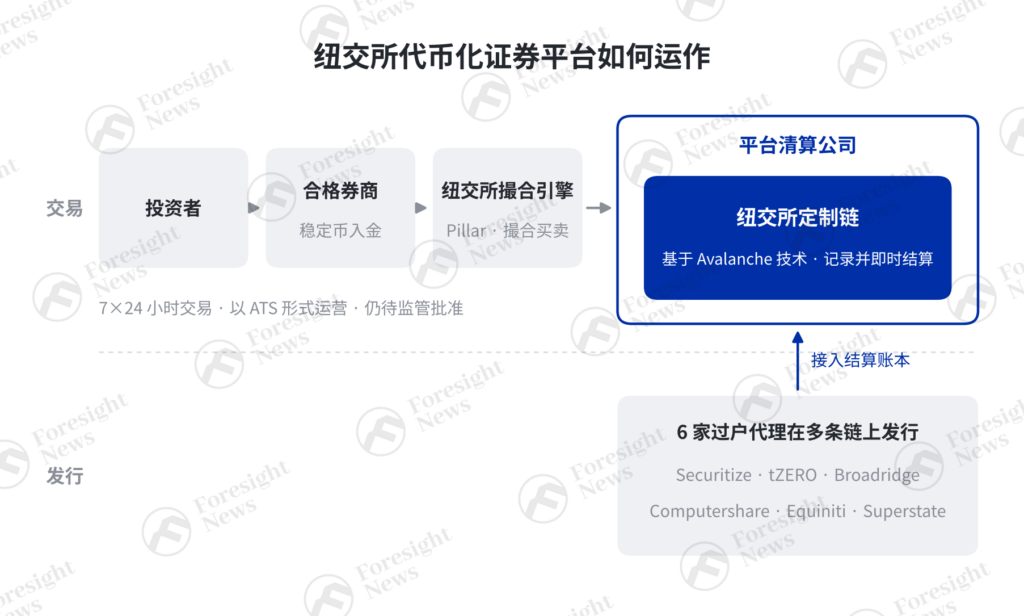
Under the plan disclosed on 9 November, matching stays on the exchange’s existing Pillar engine. After a trade, the platform’s clearing company settles it immediately on an Avalanche ledger. Investors were described as able to deposit with stablecoins.
That ledger is not the public Avalanche C-Chain. John Nahas, chief business officer at Ava Labs, said in an interview that the exchange would not settle on Avalanche’s public chain. It would operate a blockchain based on Avalanche technology and customized to regulatory requirements.
The handoff is therefore narrow: Pillar matches the order, the clearing company writes settlement on an exchange-operated chain, and the public C-Chain is not the settlement record.
After the news, Bitget prices cited in the original report showed AVAX touching 9.01 USDT and quoted at 8.627 USDT as of publication, a 6.86 percent gain over 24 hours. Those figures are a market print from that report, not a later price.
Issuance can be spread out; the settlement record is not
On 2 November 2026, NYSE set out the issuance side. Besides Securitize and tZERO, it added Broadridge, Computershare, Equiniti, and Superstate as transfer agents, taking the partner count to six.
Tokens on the platform are of two kinds: issued by a custody institution, or issued by the issuer. Both were described as interchangeable with the traditional shares, with holders receiving the same dividends and voting rights. The report does not describe a lock, burn, or mint that moves a share from one chain onto another. It describes interchangeable tokens and one settlement ledger.
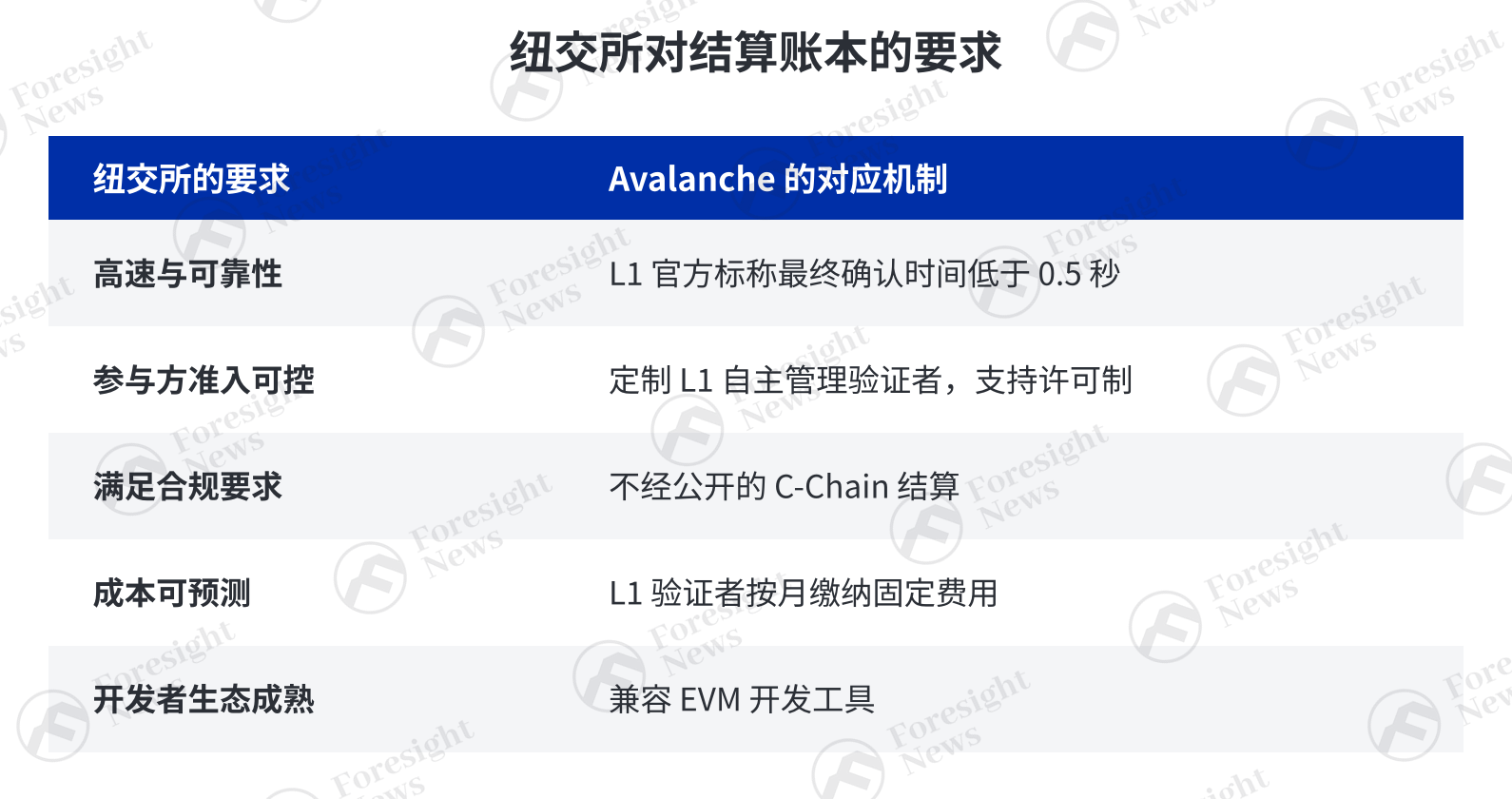
Dennis Lee, NYSE’s head of digital issuance, said the platform can support stocks issued on multiple chains, but the ledger that records and settles trades needs to be fast and reliable, able to control participants, predictable in cost, and supported by a large developer community. He said Avalanche met all of those conditions. Issuance stays dispersed across transfer agents and chains. Settlement is gathered onto the exchange’s own chain.
The trust boundary is who may participate
In its 19 January 2026 announcement, NYSE said the platform could support multiple chains for settlement and custody. By November, settlement had been narrowed to Avalanche only.
Kevin Tyrrell, the exchange’s chief product officer, said several vendors were tested beforehand, with emphasis on speed, throughput, and support for a controlled network and compliance requirements. Nahas said the technical, commercial, and ecosystem review before selection took more than a year.
The original report treats control of participants as the most important of the conditions Lee listed. Parties to stock settlement must be admitted. Avalanche’s C-Chain is a public chain anyone can join, so it does not meet that requirement.
The custom chain corresponds to the self-built L1 model Avalanche introduced after the Etna upgrade (ACP-77). These networks were previously called subnets. An institution’s L1 runs independently of the mainnet and manages its own validator set. It can be permissioned. Validators do not have to stake 2,000 AVAX and become mainnet validators first. They pay a fixed monthly fee, which is what the design cites for predictable cost.
That is not shared security with the public network. Settlement validators are the operator’s set, not an open C-Chain set. A separate claim, from Ava Labs chief executive Emin Gün Sirer in the announcement, is that this dedicated infrastructure can still connect to a wider set of assets and liquidity, and that Avalanche L1s can reach one another through native cross-chain messages. The report does not describe a production message path already carrying these settlements off the exchange’s chain.
How the selection was sequenced
- 19 January 2026: NYSE said it was developing the platform and seeking regulatory approval.
- 31 August 2026: Parent Intercontinental Exchange (ICE) signed a memorandum of understanding with tZERO.
- September 2026, Avalanche Summit: Ava Labs president Charley Cooper said the exchange had tested Avalanche for about a year. No selection was announced then.
- 9 November 2026, NYSE Live: Cooper said this was a production deployment, not another pilot.
Where AVAX sits relative to the settlement route
Neither the Ava Labs announcement nor the NYSE statement, as reported, mentioned AVAX being used for settlement, for fees on this platform, or for staking on it.
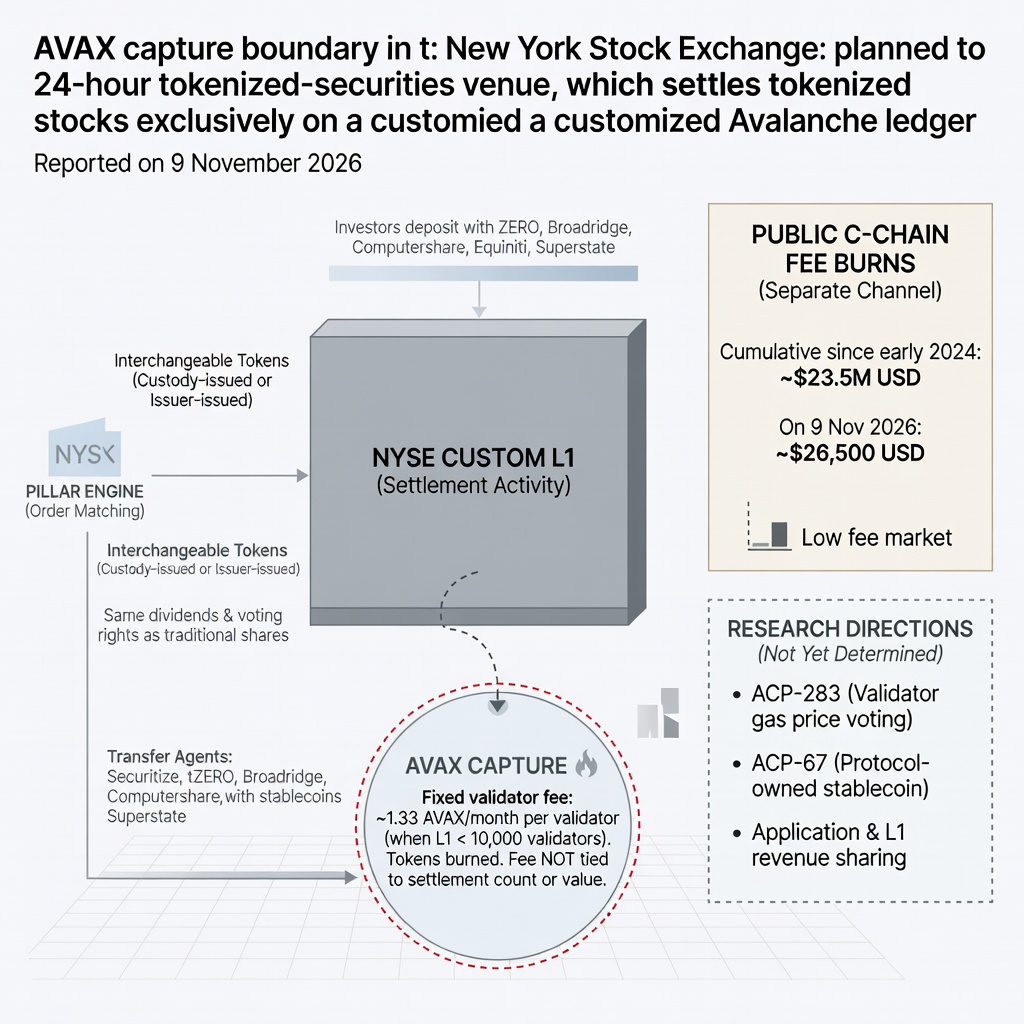
Under the custom-L1 mechanism as described from Avalanche documentation, direct AVAX revenue is the ongoing validator fee. When an L1 has fewer than 10,000 validators, each validator pays about 1.33 AVAX a month, and those tokens are burned. The fee is not tied to settlement count or value. Fees inside the L1 can be priced in a token the operator chooses.
On that mechanism, settlement activity on the NYSE chain is outside AVAX capture. Only the validator fee touches AVAX.
The foundation had already described this gap. On 30 July 2026, when it published an economic research agenda, it acknowledged that value created by the ecosystem does not automatically flow to the AVAX that secures the network. Chief investment officer Matias Antonio called that the core problem the foundation was working on.
An estimate published by the foundation on 12 August 2026 said that, in the on-chain activity it counted, the main capture for AVAX was C-Chain fee burns: about 23.5 million US dollars cumulative since early 2024, excluding L1 validator fees. L1 revenue sharing was still being studied, with no mechanism set.
The latest month in that estimate was June. Nominal gross chain product, described as similar to on-chain GDP, was 3.1 million US dollars. Returns to holders from tokenized funds and similar assets were 2.7 million US dollars. Earnings issuers took from reserve assets were 6.9 million US dollars. The foundation’s view was that the latter two were, at that point, basically not contributing to AVAX value capture.
Directions it listed, all still in research, were ACP-283 (validators voting to adjust the gas price), ACP-67 (a protocol-owned stablecoin), and revenue sharing from applications and L1s.
The C-Chain, the main capture channel in that estimate, was not a large fee market on the day of the report. DefiLlama figures cited for 9 November put Avalanche C-Chain fees at about 26,500 US dollars.
On the day the news was announced, the Avalanche Foundation said on X that it would use the economic research agenda to track the platform’s activity and its role in the Avalanche economy.
A separate Avalanche RWA snapshot
rwa.xyz figures cited as of 9 November 2026, for Avalanche as a whole, were 1.43 billion US dollars of distributed real-world assets (freely transferable between wallets), 11.4 billion US dollars of represented real-world assets (ownership recorded on-chain only), and 795 million US dollars of stablecoin market value. The report does not identify those totals as the NYSE platform’s own book.
As of the 10 November 2026 report, the fourth-quarter launch target still required regulatory approval.
Source: odaily.news (originally published 2026-11-10 18:00 UTC+8)