
Originally reported on November 11, 2026, at 19:35 (UTC+8). The architecture and performance claims below come from the original article; they are not independently verified here.

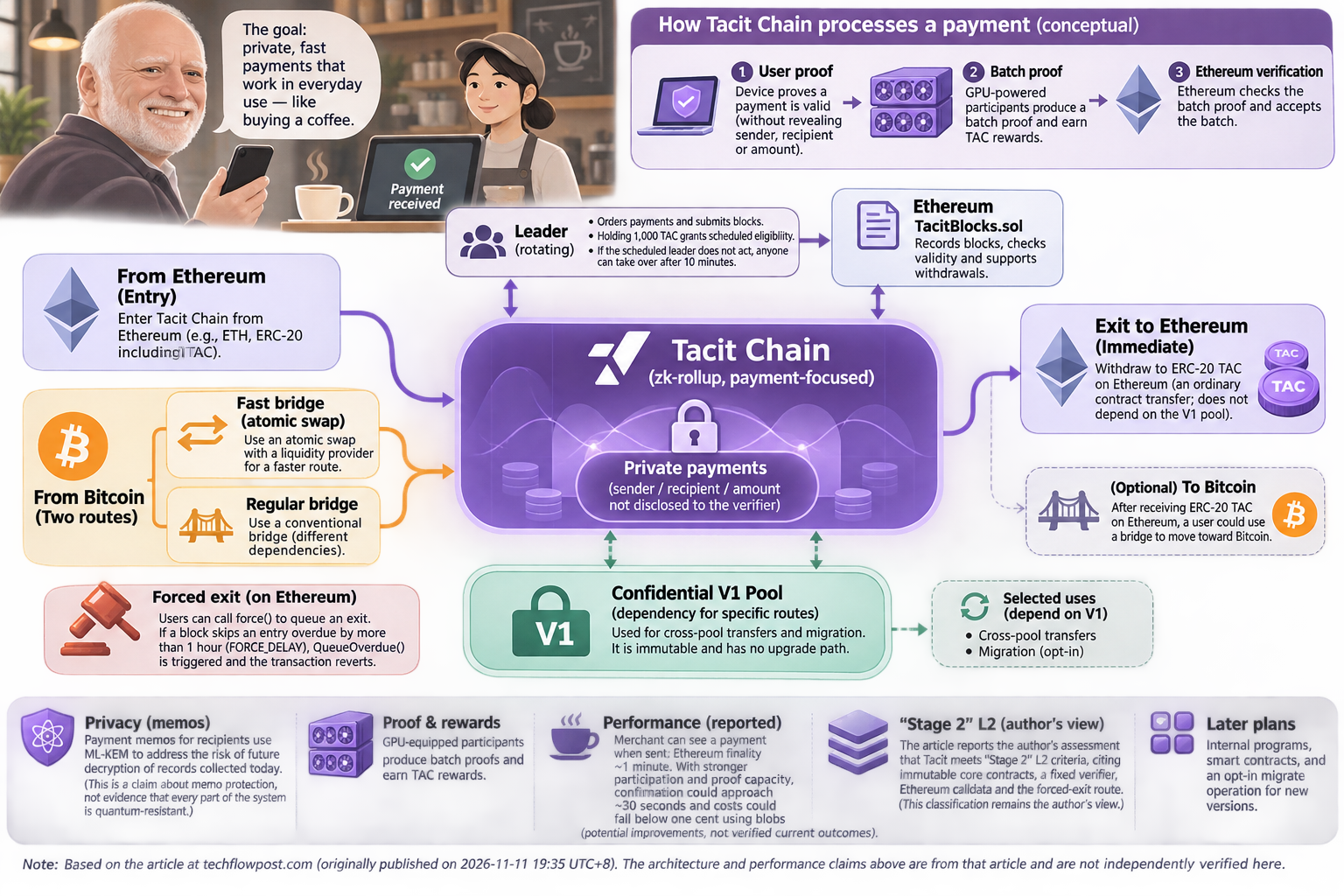
Tacit Chain is presented as a payment-focused zk-rollup prototype. Its proposed route separates a private payment from the proof Ethereum checks: a user’s device proves a payment is valid without disclosing the sender, recipient or amount to the rollup verifier; a second proof checks the processed batch before Ethereum accepts it. The article describes GPU-equipped participants producing batch proofs and earning TAC rewards.

Where payments and exits depend on other systems
A rotating participant, called a leader, orders payments and submits blocks to the Ethereum contract TacitBlocks.sol, which the article says records blocks, checks validity and supports withdrawals. Holding a 1,000 TAC seat grants scheduled eligibility. If the scheduled leader does not act, anyone can take over after 10 minutes. The article says transaction data is posted to Ethereum as calldata so nodes can reconstruct the state.
Users can enter from Ethereum. For Bitcoin, the article describes either a regular bridge or a “fast bridge” using an atomic swap with a liquidity provider. Those are distinct routes with different dependencies; the article does not establish that every Bitcoin transfer has the same trust assumptions. It describes an immediate exit to ERC-20 TAC on Ethereum, after which a user could use a bridge to move toward Bitcoin. A separate forced-exit mechanism queues force() requests on Ethereum: according to the article, a block that skips an entry overdue by more than the one-hour FORCE_DELAY triggers QueueOverdue() and reverts.
One stated dependency is the confidential V1 pool used for cross-pool transfers and migration. The article says that pool is immutable and has no upgrade path, but users of those routes still rely on its construction. It says a withdrawal of TAC to Ethereum is an ordinary contract transfer and does not depend on V1.
Privacy and claims still to assess
The article says payment memos for recipients use ML-KEM to address the risk of future decryption of records collected today. That is a claim about memo protection, not evidence that every part of the system is quantum-resistant. It also reports the author’s view that Tacit meets “Stage 2” L2 criteria, citing immutable core contracts, a fixed verifier, Ethereum calldata and the forced-exit route. That classification remains the author’s assessment.
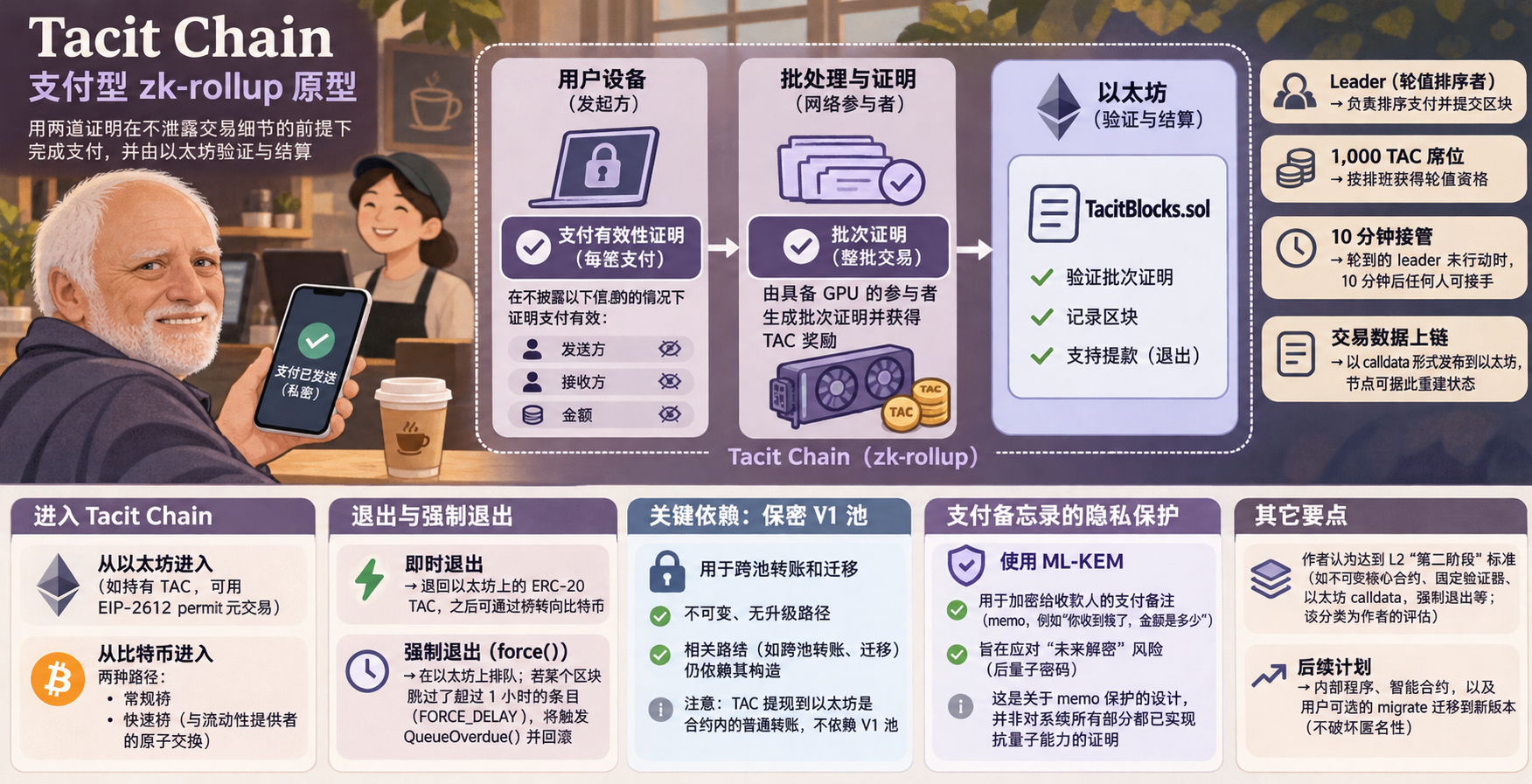
For the coffee-shop test motivating the design, the article claims a merchant can see a payment when it is sent and that Ethereum finality follows in about one minute. It presents confirmation approaching 30 seconds with stronger participation and proof capacity, and costs below one cent using blobs, as potential improvements—not verified current outcomes. Proposed later features include internal programs, smart contracts and an opt-in migrate operation for new versions.
Source: techflowpost.com (originally published 2026-11-11 19:35 UTC+8)