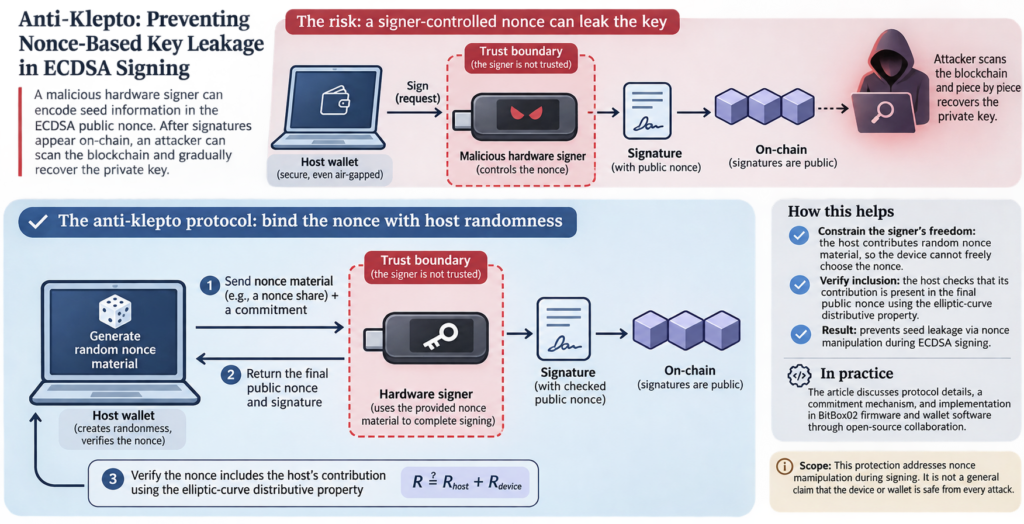
An article dated November 5, 2026, explains a custody risk that does not depend on compromising the host wallet: a malicious hardware signer could encode seed information in the public nonce used for an ECDSA signature. Once signatures appear on-chain, an attacker scanning the blockchain could gradually piece together the private key. According to the article, a secure host and an air-gapped device would not, by themselves, prevent that form of leakage.
The anti-klepto protocol addresses the signer’s freedom to choose the nonce. The host wallet contributes random nonce material, then uses the elliptic-curve distributive property to check that its contribution is present in the final public nonce. This constrains what the device can select on its own.
The article also discusses protocol details, a commitment mechanism, and implementation in BitBox02 firmware and wallet software through open-source collaboration. Its described protection concerns nonce manipulation during signing; it is not a general claim that the device or wallet is safe from every attack.