Democrats won both chambers of Congress in the November 2026 midterms. When the new Congress takes office on January 3, 2027, it can investigate federal crypto policy, block bills and, in the Senate, withhold confirmation of regulators. It cannot cancel a presidential order or direct an agency to withdraw a rule. Donald Trump retains the veto until January 2029, and Democrats are well short of the two-thirds majorities needed to override it: 67 votes in the Senate and 290 in the House.
For a bank, wallet developer or stablecoin issuer, the important question is which legal instrument its business relies on. A wallet may rely on a staff letter saying regulators will not recommend enforcement. A bank may hold a federal charter that regulators need cause to revoke. A stablecoin issuer faces requirements written into federal law. All three can experience a change in supervision; only the first can lose the basis for its regulatory position with the withdrawal of a letter.
Here is where the 36 measures stood on November 26, 2026, and what would have to happen to change them.
Guidance, executive orders and unfinished rules: 13 measures that can change quickly
-
SEC staff positions. In 2025, Securities and Exchange Commission staff said that the meme coins, proof-of-work mining, covered stablecoins and protocol staking activities described in their statements did not involve securities offerings. The May 29 staking statement did not cover liquid staking or restaking; a later statement addressed specified liquid staking arrangements and receipt tokens. On December 17, staff explained how a broker could demonstrate possession of crypto asset securities under Rule 15c3-3 by controlling the private keys and retaining the ability to transfer the assets. A January 28, 2026 statement distinguished issuer-tokenized securities from third-party custodial and synthetic versions; tokenization did not change their status as securities. On April 13, staff said they would not recommend broker-registration enforcement against qualifying interfaces that neither hold user assets nor recommend particular trades. That position expires after five years unless the commission acts. None of these statements received a commission vote or binds a future SEC.
-
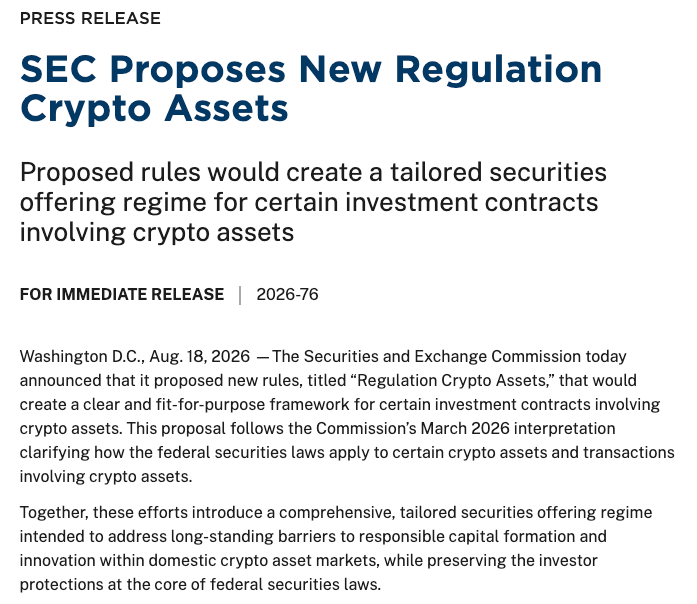
The SEC’s proposed Regulation Crypto Assets. The August 18, 2026 proposal included a $5 million startup exemption, fundraising tiers capped at $20 million and $75 million, a safe harbor and provisions preempting state law. Comments closed October 20. The SEC had not adopted the rule, so issuers could not rely on the proposed exemptions. The agency could abandon or rewrite the text; changing a final rule would require another rulemaking.
-
The CFTC’s retail crypto market proceeding. The Commodity Futures Trading Commission sent an advance notice of proposed rulemaking, RIN 3038-AF80, for White House review on September 17, 2026. Its 60-day comment period subsequently closed. The proceeding concerns leveraged, margined or financed retail commodity transactions under Section 2(c)(2)(D) of the Commodity Exchange Act, which generally must take place on a designated contract market unless an exception applies. The notice explored what constitutes an offer or actual delivery and excluded payment stablecoins from GENIUS-permitted issuers from its crypto asset definition. It was not a final trading rule. For fully paid spot transactions, the CFTC’s authority remains limited to fraud and manipulation.
-
CFTC collateral and wallet guidance. December 2025 staff letters addressed tokenized Treasuries and money market fund shares as collateral. Letter 26-05 took a no-action position on futures commission merchants accepting non-security digital assets, including bitcoin, ether and payment stablecoins, as customer margin. March 20, 2026 guidance distinguished uncleared swaps, where crypto itself does not qualify but tokenized eligible collateral can qualify if it confers the same legal and economic rights, from clearinghouses, which can accept crypto as initial margin subject to credit, market and liquidity requirements. Staff issued further FAQs on September 24. A separate March 17 letter covered Phantom Technologies; September 17 letter 26-25 extended the conditional no-action position to passive software providers that route users to regulated intermediaries or designated contract markets. It is a staff enforcement position, not a permanent registration exemption.
-
Pending GENIUS implementation. About 13 rules remained at the proposal stage in November 2026. Treasury, the Office of the Comptroller of the Currency (OCC), the Federal Deposit Insurance Corporation (FDIC), the National Credit Union Administration and the Financial Crimes Enforcement Network have responsibilities ranging from issuer supervision to anti-money-laundering requirements. Treasury’s interim final rule on the state certification process took effect September 30. Its April proposal on what makes a state regime “substantially similar” to federal standards was not final. Regulators can change proposed requirements, but cannot discard their statutory duty to implement the law.
-
The federal CBDC restriction. Executive Order 14178, signed January 23, 2025, backed digital asset development, barred federal agencies from advancing a central bank digital currency and created the President’s Working Group on Digital Asset Markets. A successor could rescind the order. Congress has not enacted a corresponding CBDC ban.
-
The fair banking order. Executive Order 14331 of August 7, 2025 directed regulators to review politically motivated or unlawful denial of banking services to lawful businesses, not just crypto firms. It created no independently enforceable right. Venture investor Nic Carter used “Operation Choke Point 2.0” to describe what he alleged was a coordinated effort to cut crypto firms off from banks after three crypto-friendly banks failed. That allegation remains disputed. Trump declared the operation over at a March 2025 White House summit. Rescinding his order would not by itself repeal the subsequent OCC and FDIC rule.
-
The financial technology review. Executive Order 14405, issued May 19, 2026, gave financial regulators 90- and 180-day deadlines to review barriers to fintech and crypto activity. It also called for a Federal Reserve report on access to payment accounts. A successor could revoke the directive.
-
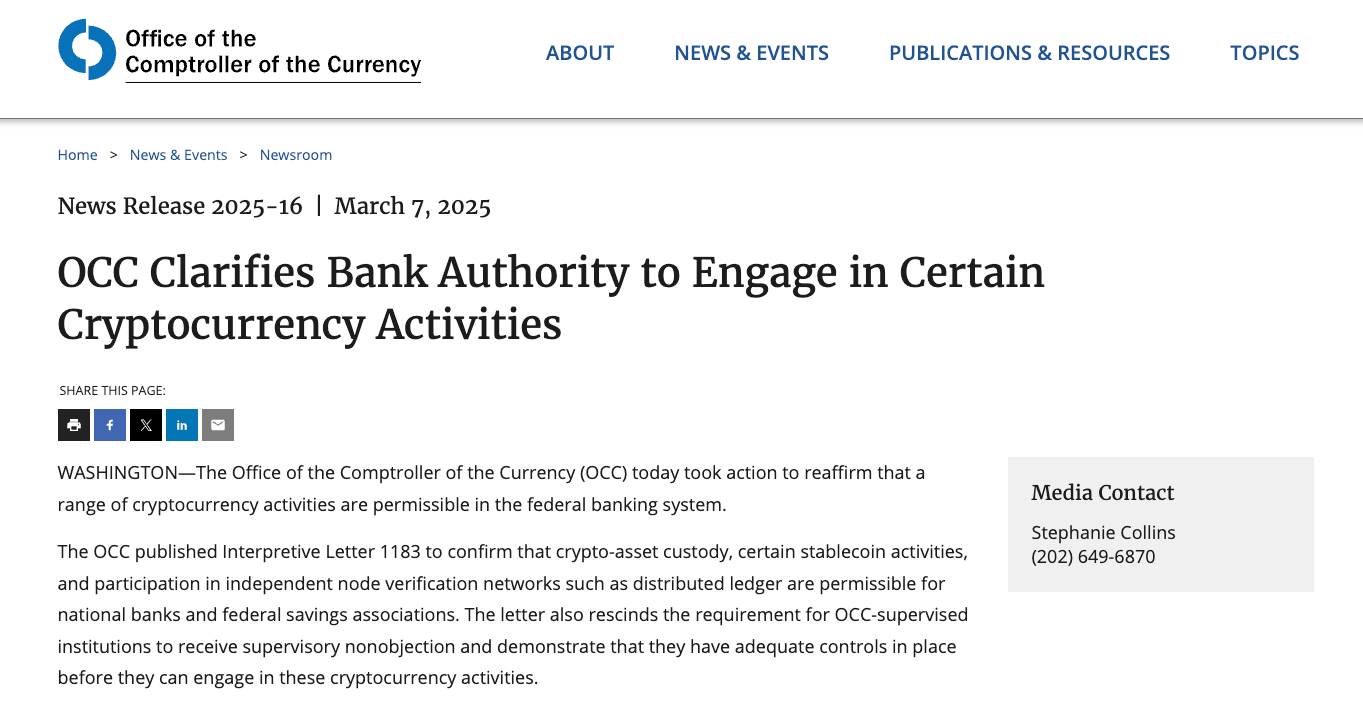
OCC letters on bank operations. Letter 1183 confirmed that banks could participate in distributed ledger activities, including node validation, and withdrew letter 1179’s requirement for prior supervisory non-objection. Letter 1184 allowed banks to transact in assets in custody at a customer’s direction and outsource permissible custody services. Letter 1186 allowed national banks to pay network fees for authorized activities and hold crypto to test permissible platforms. A new comptroller could withdraw these interpretations, just as 1183 displaced 1179.
-
FDIC and Fed supervisory guidance. FDIC letter FIL-7-2025 removed the advance-notification requirement for banks undertaking crypto activities. The Fed withdrew earlier crypto guidance on April 24, 2025 and ended its novel activities supervision program and supervisory letter SR 23-7 on August 15. Regulators could issue fresh supervisory guidance without public notice and comment.
-
Limited Fed payment accounts. A master account gives an institution direct access to Fed payment and settlement systems instead of requiring it to go through a partner bank. Kraken received a limited 12-month pilot in March 2026. The Fed’s May 20 payment-account proposal, docket OP-1878, would offer narrower access to fintech and crypto firms. Comments closed July 27; the proposal was not final, and decisions on some Tier 3 applications were paused until year-end. The pilot did not establish a general right of access. The proposal’s future depends more directly on the Fed board than on the presidential election.
-
Justice Department prosecution policy. Deputy Attorney General Blanche’s April 7, 2025 memorandum, Ending Regulation by Prosecution, directed prosecutors away from using criminal cases to enforce regulatory requirements and dissolved the National Cryptocurrency Enforcement Team. A new attorney general could change that policy prospectively, but doing so would not restore expired limitation periods or readily revive abandoned cases.
-
The presidential working group report. The group’s July 2025 recommendations covered stablecoins, market structure, taxes and banking. Agencies adopted some recommendations, but the report itself is neither a statute nor a rule. A future administration can stop using it; changing an action already taken on its advice is a separate matter.
Three measures where undoing the paperwork would not undo the business
-
Crypto in 401(k) plans. Executive Order 14330 of August 7, 2025 directed the Labor Department to reconsider how alternative assets, including crypto, could enter employer retirement plans. The department proposed a rule on March 30, 2026 and sent final-rule text to the White House Office of Information and Regulatory Affairs for review in November. Submission for review was not publication. Once issued, a final rule would generally require a new rulemaking to reverse; rescinding the order alone would not suffice.
-
The Strategic Bitcoin Reserve and Digital Asset Stockpile. Executive Order 14233 of March 6, 2025 established both. The bitcoin reserve was designed to retain BTC obtained through criminal or civil forfeiture. No open-market purchase plan had been announced. BitcoinTreasuries estimated total US government holdings at about 328,372 BTC; that is not a confirmed reserve balance. Reports also described a custody dispute between Treasury and Commerce. A successor could revoke the order and resume sales, but forfeiture proceedings and restitution obligations would still constrain which coins the government could sell.
-
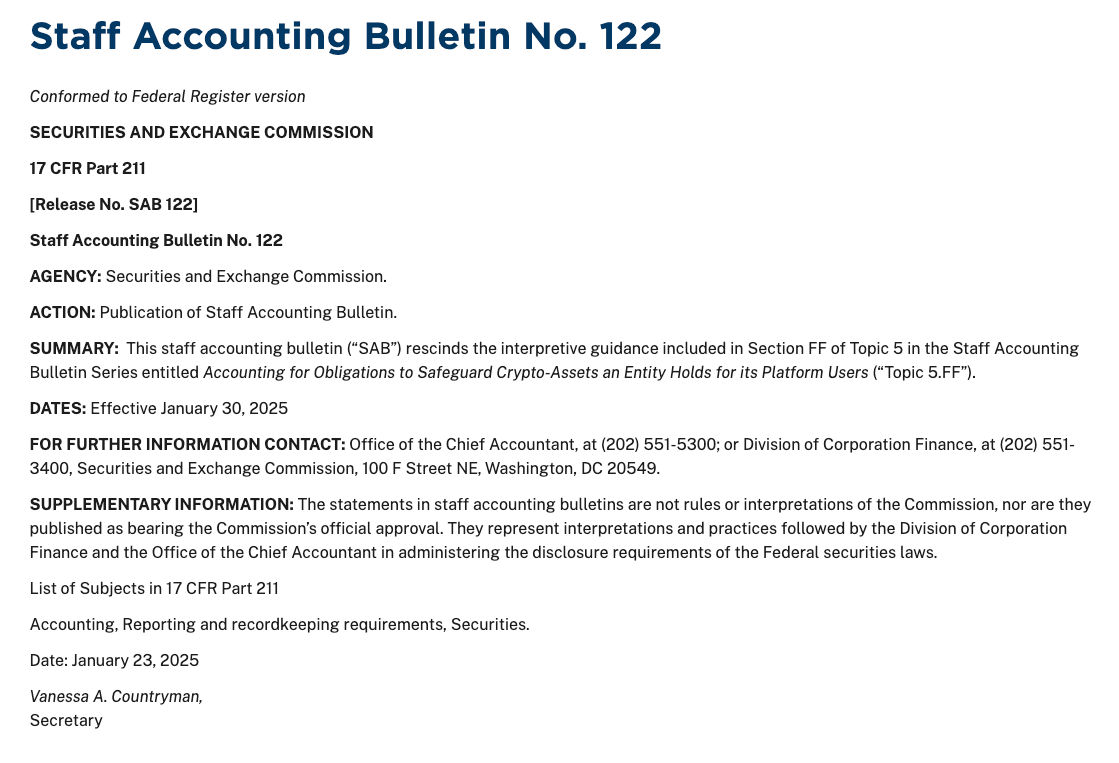
Custody accounting. In January 2025, SEC staff issued SAB 122 to rescind SAB 121, the 2022 bulletin requiring firms safeguarding customer crypto to recognize a corresponding balance-sheet liability. This was a staff action, not a congressional repeal: Joe Biden vetoed Congress’s 2024 disapproval resolution. Staff could reissue the accounting position, but banks that built custody products and hired teams after its withdrawal would face the cost of changing course.
Eight decisions that require more than a change in staff guidance
-
The SEC–CFTC token classification. A March 17, 2026 commission-level interpretation divided crypto assets into digital commodities, collectibles, tools, stablecoins and digital securities. The agencies could withdraw it without notice and comment. Unlike a staff statement, however, it was adopted by commission vote; an abrupt reversal that ignored businesses’ reliance on it could face an arbitrary-and-capricious challenge.
-
Onchain trading of tokenized stocks. SEC Release 34-106402, issued September 17, 2026, granted a conditional five-year exemption for tokenized National Market System stocks. These are securities represented by tokens linked to listed shares. The exemption runs to September 17, 2031, but the SEC can modify or terminate it by order without a full rulemaking. Chair Paul Atkins said durable rules would still be needed.
-
National trust bank charters. Final OCC approvals included Ripple in October 2026 and Circle, BitGo and Coinbase in November. Final charters support nationwide custody and stablecoin-related activities without separate state-by-state licensing; revocation requires cause. Paxos, Fidelity Digital Assets, Crypto.com, Bridge, Protego and World Liberty Trust had conditional approvals, which the OCC could delay or decline to finalize. The Independent Community Bankers of America sued in October to challenge the OCC’s authority to issue these charters. Democratic lawmakers said they would investigate the August conditional approval for World Liberty Trust, affiliated with the Trump family’s World Liberty Financial.
-
The OCC’s final stablecoin rule. Unlike the pending GENIUS proposals, 12 CFR Part 15 was final but not yet effective. The OCC issued the 721-page rule on October 21, 2026; it was published October 23 and takes effect January 18, 2027. It sets a $5 million minimum capital floor, stress tests and liquidity buffers, permits short-term Treasury repos with prior approval and provides an exemption process for issuers applying before the effective date. The preamble asserts authority to address circumvention of the yield ban. Changing the rule requires public comment and a reasoned explanation, a process generally taking one to two years.
-
Closed SEC investigations. The SEC closed investigations into Robinhood Crypto, Uniswap Labs, Crypto.com, OpenSea, Yuga Labs and Gemini in 2025 without enforcement action. Closure is not a judgment. A future commission could in principle reopen an inquiry within the applicable limitations period, identified as five years for penalties, although the cost of rebuilding evidence makes reopening uncommon.
-
Generic ETF listing standards. On September 17, 2025, the SEC approved rule changes for Nasdaq, Cboe BZX and NYSE Arca allowing qualifying commodity trust shares, including crypto products, to list without case-by-case approval. A future SEC could seek changes from the exchanges or review standards under Section 19 of the Securities Exchange Act. Changing the route to listing would not automatically delist products already trading.
-
The bank reputation-risk rule. The OCC and FDIC issued a final rule on April 7, 2026 removing reputation risk from their supervisory framework and prohibiting regulator-driven debanking. It took effect June 9; a separate final rule on unsafe or unsound practices followed in August. Reversal would generally require 12 to 24 months of rulemaking and could face an Administrative Procedure Act challenge.
-
Tornado Cash sanctions. Treasury’s Office of Foreign Assets Control removed the Ethereum mixing protocol from its sanctions list in March 2025, after listing its smart contract addresses in 2022. OFAC could consider a new designation, but the Fifth Circuit’s ruling on immutable smart contracts in Van Loon limits its ability to reimpose the previous sanctions.
Eight outcomes protected by statute, finality or existing investors
-
In-kind ETF creation and redemption. On July 29, 2025, the SEC approved in-kind transactions for bitcoin and ether exchange-traded products. Authorized participants could deliver or receive the underlying asset rather than settle exclusively in cash, reducing operating costs and tax friction. The protection here is practical, not statutory: a return to cash-only settlement would disrupt a process fund operators already use.
-
The GENIUS Act. Public Law 119-27, signed July 18, 2025, established the first federal stablecoin licensing and supervisory framework, required high-quality reserves and restricted issuers from paying yield directly to holders. It passed the Senate 68–30, with 18 Democrats in favor, and the House 308–122, with 206 Republicans and 102 Democrats in favor. The effective date is the earlier of 18 months after enactment or 120 days after final implementing rules. Regulators missed the July 18, 2026 rulemaking deadline, making January 18, 2027 the operative date under the 18-month provision. An agency can tighten capital or reserve requirements within its authority; only Congress can change the statute. Targeted amendments on yield circumvention or officials’ crypto holdings are more plausible than wholesale repeal.
-
Spot crypto funds already trading. US listings since October 2025 included SOL products, among them the staking ETF BSOL, as well as XRP, LTC, HBAR, DOGE, LINK and the multi-asset GDLC. Morgan Stanley counted about 140 US-listed crypto-related exchange-traded products, roughly 40 of them single-asset spot products. Compelling funds with existing investors to delist would be an exceptional step, not a routine consequence of revising listing standards.
-
Repeal of the IRS DeFi broker rule. H.J.Res. 25 passed the Senate 70–28 and the House 292–132. Trump signed it on April 10, 2025 as Public Law 119-5, and Treasury removed the rule from federal regulations on July 11. The rule would have required certain DeFi participants to report users’ transactions as brokers; the industry argued that protocols lacking user identity information could not comply. Because Congress used the Congressional Review Act (CRA), the IRS cannot issue a substantially similar rule without fresh congressional authorization. Form 1099-DA reporting for custodial brokers, beginning with tax year 2025, was not repealed.
-
Presidential pardons. Trump’s 2025 pardons covered Silk Road operator Ross Ulbricht, the BitMEX founding team and Binance founder CZ. Unlike an executive order, a delivered pardon cannot be revoked by a successor.
-
SEC cases dismissed with prejudice. Between February and May 2025, the SEC dropped cases involving Coinbase, Kraken, Consensys, Cumberland DRW, Dragonchain, Balina and Binance. The cases had alleged unregistered securities-related activity. The dismissals were reported as being with prejudice, which bars the commission from bringing the same claims again. That is a different legal outcome from closing an investigation.
-
The Ripple judgment. The SEC sued Ripple in 2020 over sales of XRP. Both sides withdrew their appeals in August 2025, leaving the district court’s $125 million penalty intact. The court did not approve their proposal to reduce it to $50 million. A change in SEC leadership cannot reopen that final judgment.
-
The Justin Sun and Tron resolution. Under the March 5, 2026 resolution, Rainberry Inc. paid $10 million. Claims against Sun and the related foundations were dismissed with prejudice. Those claims, too, reached a final disposition.
Four legislative initiatives that never became law
-
The CLARITY market structure bill. The House voted 294–134 for the bill on July 17, 2025, with 216 Republicans and 78 Democrats in favor. The Senate Agriculture Committee advanced its digital commodity intermediary bill 12–11 on January 29, 2026, and the Banking Committee voted 15–9 to report its measure on May 14, with two Democrats in favor. On September 15, however, cloture on the motion to proceed failed 49–50, 11 votes short of the 60 required. All Democrats and four Republicans voted against it. Orrick identified officials’ crypto holdings and stablecoin yield as principal disputes. Senator Tillis’s reconsideration motion kept the bill procedurally alive, but Orrick, DLA Piper and Troutman Pepper Locke saw little prospect of passage in that Congress. As Troutman Pepper Locke noted, agency rules cannot substitute for several provisions, including CFTC licensing of spot intermediaries, customer property priority in bankruptcy and broad preemption of state law.
-
The Anti-CBDC Surveillance State Act. H.R. 1919 would prohibit the Fed from issuing a retail CBDC. The House passed it 219–210 on July 17, 2025 and included the language in its April 29, 2026 amendment to S. 1318. The Senate did not agree. The federal restriction therefore still rests on Executive Order 14178, not a statute.
-
The Digital Asset Tax Certainty Act. H.R. 10357 proposed a $10 gas-fee exemption, application of wash-sale rules to crypto and clarification of staking and mining income. The wash-sale provision would prevent investors from claiming a loss when they sell and repurchase the asset within 30 days. The House Ways and Means Committee approved the bill 38–5 on September 16, 2026. Neither chamber had voted on it. Ron Wyden, expected to chair Senate Finance, was a key figure in its prospects.
-
Bitcoin reserve legislation. Senator Lummis’s BITCOIN Act, S. 954, proposed federal bitcoin purchases over multiple years. A separate measure, the American Reserve Modernization Act, cleared the House Financial Services Committee 28–21 on September 16, 2026. Neither became law. Neither should be confused with the executive order directing the government to retain forfeited BTC.
The immediate test is oversight, not repeal
From January 2027, Democrats can scrutinize World Liberty Financial, its USD1 stablecoin, the $TRUMP meme coin and the OCC’s conditional World Liberty Trust charter. Elizabeth Warren, Maxine Waters and Robert Garcia were expected to lead the Senate Banking, House Financial Services and House Oversight committees, respectively; Sherrod Brown was reported as a prospective Senate Agriculture chair. Those were prospective leadership assignments, not completed investigations.
Confirmations also matter. The SEC had no Democratic commissioner, and after Hester Peirce announced her impending departure on September 25, 2026, only Atkins and Mark Uyeda remained. Atkins’s term expired in June 2026, though SEC commissioners may serve up to 18 additional months, in his case roughly through the end of 2027. Michael Selig, confirmed 53–43 on December 18, 2025, was the CFTC’s only commissioner. The Senate can decline to fill vacancies without passing any crypto legislation. TD Cowen analyst Jaret Seiberg warned that the political environment could leave no viable path for a version of CLARITY acceptable to the industry.
A Democratic victory in the 2028 presidential election would create a different scenario beginning in January 2029. A successor could revoke executive orders immediately. The Supreme Court’s June 29, 2026 ruling in Trump v. Slaughter, decided 6–3, overturned Humphrey’s Executor and widened the president’s ability to remove independent-agency commissioners, though statutory party-balance limits remain. New agency leaders could then withdraw letters, change exemptions and abandon proposals. Rewriting final rules would generally take longer.
Timing could matter for rules finalized late in 2028. According to the Congressional Research Service, rules submitted with fewer than 60 Senate session days or 60 House legislative days remaining can come up for review in the next Congress. That could expose late SEC, CFTC or retirement-plan rules to CRA disapproval. It does not put every earlier crypto measure back to a vote. The stablecoin statute, delivered pardons and final court judgments would remain beyond the reach of a change in agency leadership.