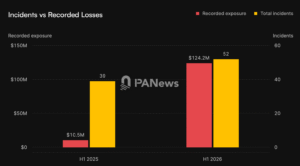
Originally reported by PA Daily on November 11, 2026, at 17:17 (UTC+8). The updates below concern different points of dependency: a bridge website’s domain, an exchange’s internal accounting, a cross-chain withdrawal limit and a blockchain’s transaction history.
Across: domain control became the point of attack
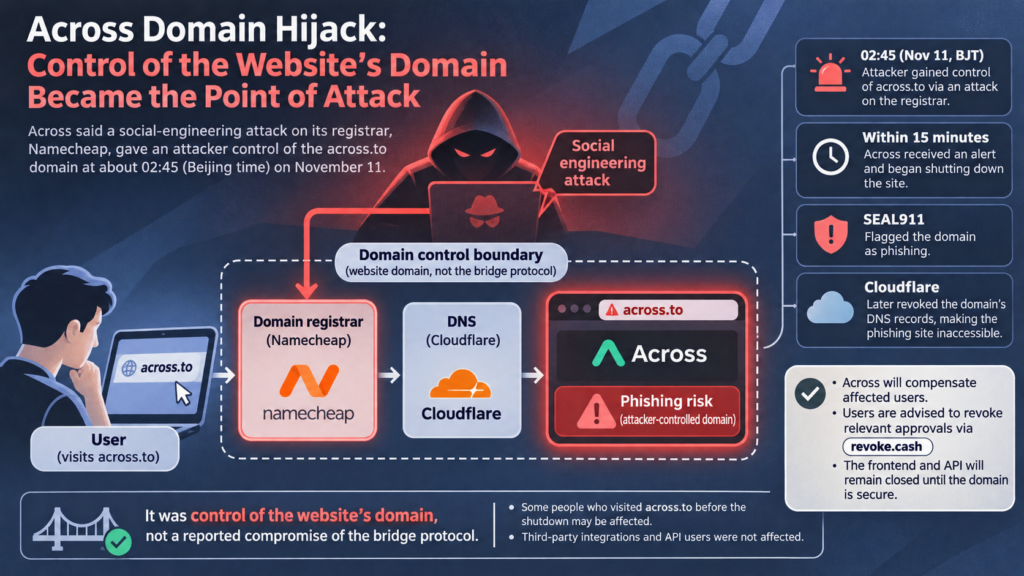
Across said a social-engineering attack on its registrar, Namecheap, gave an attacker control of the across.to domain at about 02:45 Beijing time on November 11. The team said it received an alert within 15 minutes and began shutting down the site. SEAL911 flagged the domain as phishing, and Cloudflare later revoked its DNS records, making the phishing site inaccessible.
Across said some people who visited across.to before the shutdown may be affected; it said third-party integrations and API users were not affected. It promised to compensate affected users and advised them to revoke relevant approvals through revoke.cash. Across said its frontend and API would remain closed until the domain was secure. It had not disclosed a loss amount. The reported failure was control of the website’s domain, not a reported compromise of the bridge protocol.
Arcus: an accounting flaw met a bridge withdrawal limit
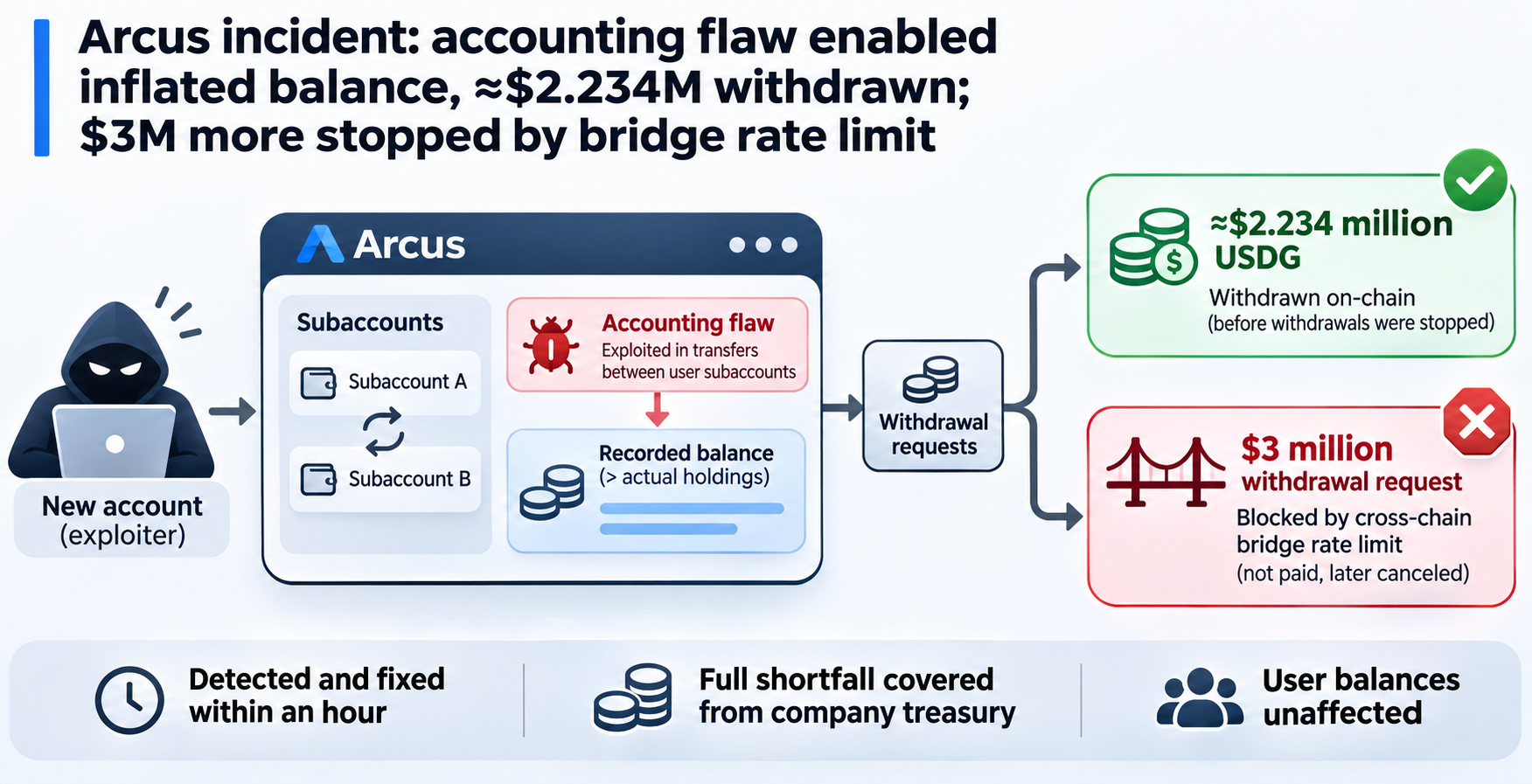
Arcus said a newly created account exploited its handling of transfers between user subaccounts at 11:07 Beijing time on November 10. The flaw let the account record a balance greater than it held and request withdrawals. Before withdrawals were stopped, about $2.234 million in USDG was withdrawn on-chain. Arcus said a cross-chain bridge rate limit blocked a further $3 million in withdrawal requests, which were not paid and were later canceled.
Arcus said it detected and fixed the flaw within an hour, covered the full shortfall from its company treasury, and that user balances were unaffected. The rate limit constrained additional withdrawals; it did not prevent the initial loss.
Waves: rollback and exchange restrictions
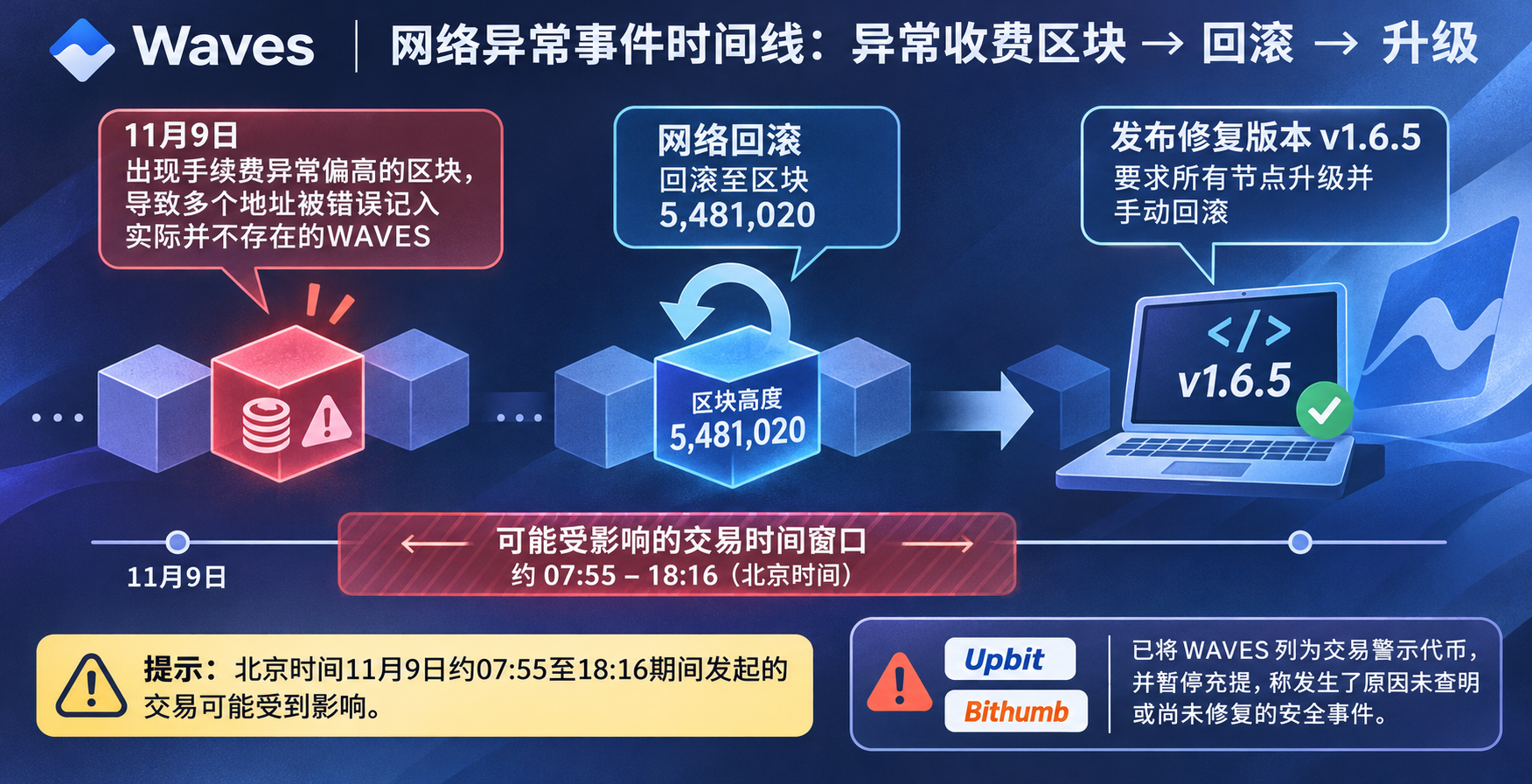
Waves said a third party produced a block with abnormally high fees on November 9, causing several addresses to be credited with WAVES that did not exist. Waves rolled the network back to block 5,481,020 and released version v1.6.5, instructing nodes to upgrade and roll back manually. It said transactions initiated between about 07:55 and 18:16 Beijing time that day may be affected.
Upbit and Bithumb designated WAVES a trading-warning token and suspended deposits and withdrawals. The exchanges cited a security event involving the wallet or distributed ledger whose cause was undetermined or unresolved; that designation should not be read as a confirmed explanation of the block incident.
Custody and cross-chain fund movements
Deutsche Bank’s digital-asset custody service was reported live for institutional and corporate clients in Germany, supporting BTC, ETH and some stablecoins, including USDC, under BaFin/MiCA authorization. The bank uses layered controls for key management. The initial service is not for retail clients, carries no deposit guarantee, and its trading functionality had not been confirmed.
Separately, Onchain Lens reported that about $891 million of the roughly $6.34 billion stolen in the Binance hack may have been moved or laundered. It said funds had moved through THORChain and Chainflip over the preceding two to three days and that neither protocol had restricted transactions from the implicated wallets. Those movements and the amount potentially laundered are the analyst’s assessment, not a confirmed accounting of recovered funds.
Source: panewslab.com (originally published 2026-11-11 17:17 UTC+8)