As reported on November 13, 2026, Variational had ended the private test of Omni, its on-chain trading application. Accounts no longer required invitation codes. The change opened a model built around one market maker to a wider group of traders, rather than establishing that it could sustain the same pricing and liquidity at greater scale.
Omni uses a request-for-quote system, not a public order book. A trader requests a price, and the Omni Liquidity Provider (OLP)—a pool initially funded by the Variational team—quotes the trade and hedges its exposure on other venues. Omni charges no trading fee, but traders pay the bid–ask spread. The protocol currently takes 20% of OLP’s spread revenue. CEO Lucas Schuermann described the approach to Bankless in September as a brokerage-like model rather than an exchange.
Volume and markets
DefiLlama showed approximately $66.4 billion in 30-day volume as of Thursday morning in the original report, up from more than $34 billion cited on September 10. It showed about $2.2 billion over the preceding 24 hours, placing Variational third among perpetual-trading platforms behind Hyperliquid, at roughly $9.84 billion, and Lighter, at roughly $2.69 billion.
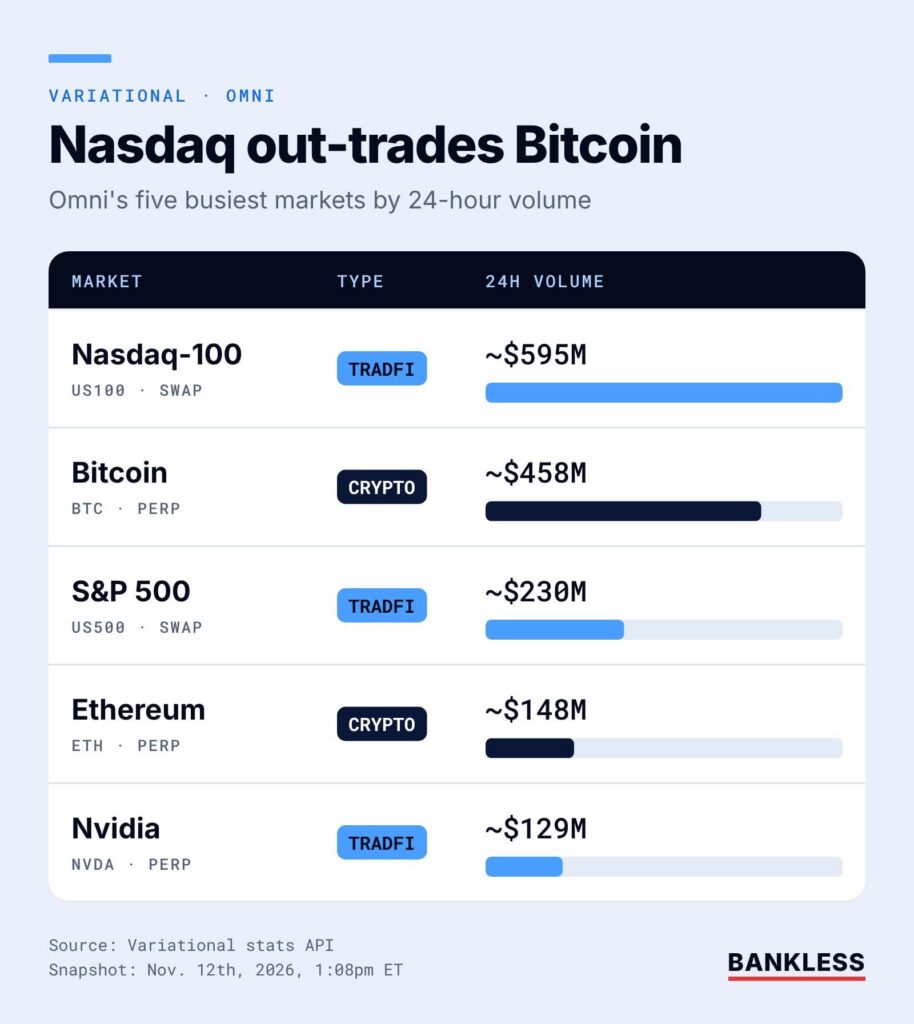
Omni’s Swaps markets offer market-maker quotes on traditional-finance exposures including gold, crude oil and equity indexes. Variational said on November 10 that cumulative Swaps volume had exceeded $80 billion and that traditional-finance markets accounted for more than 60% of Omni’s volume. Separately, Variational’s public data API showed roughly $595 million in Nasdaq 100 swaps volume and $458 million in Bitcoin volume over the 24 hours cited in the report.
Where the trust boundary sits
Each user’s collateral sits in a dedicated on-chain settlement pool, according to the account, rather than with the market maker. OLP uses its own funds to hedge elsewhere. That separation does not remove counterparty risk: OLP’s documentation says that, if it becomes insolvent, user profits accrued from that point would be treated as bad debt and could not be paid. Outside observers also cannot currently audit OLP’s hedging book.
The single quoting party raises a separate question about price competition. In an October 31 discussion on X, 0xLoris argued that Omni was not a genuine perpetual DEX and contrasted it with traditional RFQ systems in which multiple market makers compete to quote. Variational co-founder Edward Yu responded that collateral is committed transparently on-chain and that Omni must compete for users against other perpetual-trading venues. A trader can leave Omni, but cannot obtain a competing quote from another maker within its current RFQ arrangement.
Pricing comparisons remain qualified. Alea Research estimated Variational’s third-quarter spread cost at 2.35 basis points of volume, versus an average Hyperliquid perpetual fee of 2.40 basis points; its estimate relied in part on team-disclosed data. Variational also claimed that, during an early-November Nasdaq sell-off, annualized perpetual funding rates briefly exceeded 80% while funding on its Swaps markets stayed near 5%. Neither comparison establishes that those conditions will persist in public trading.
Plans still pending
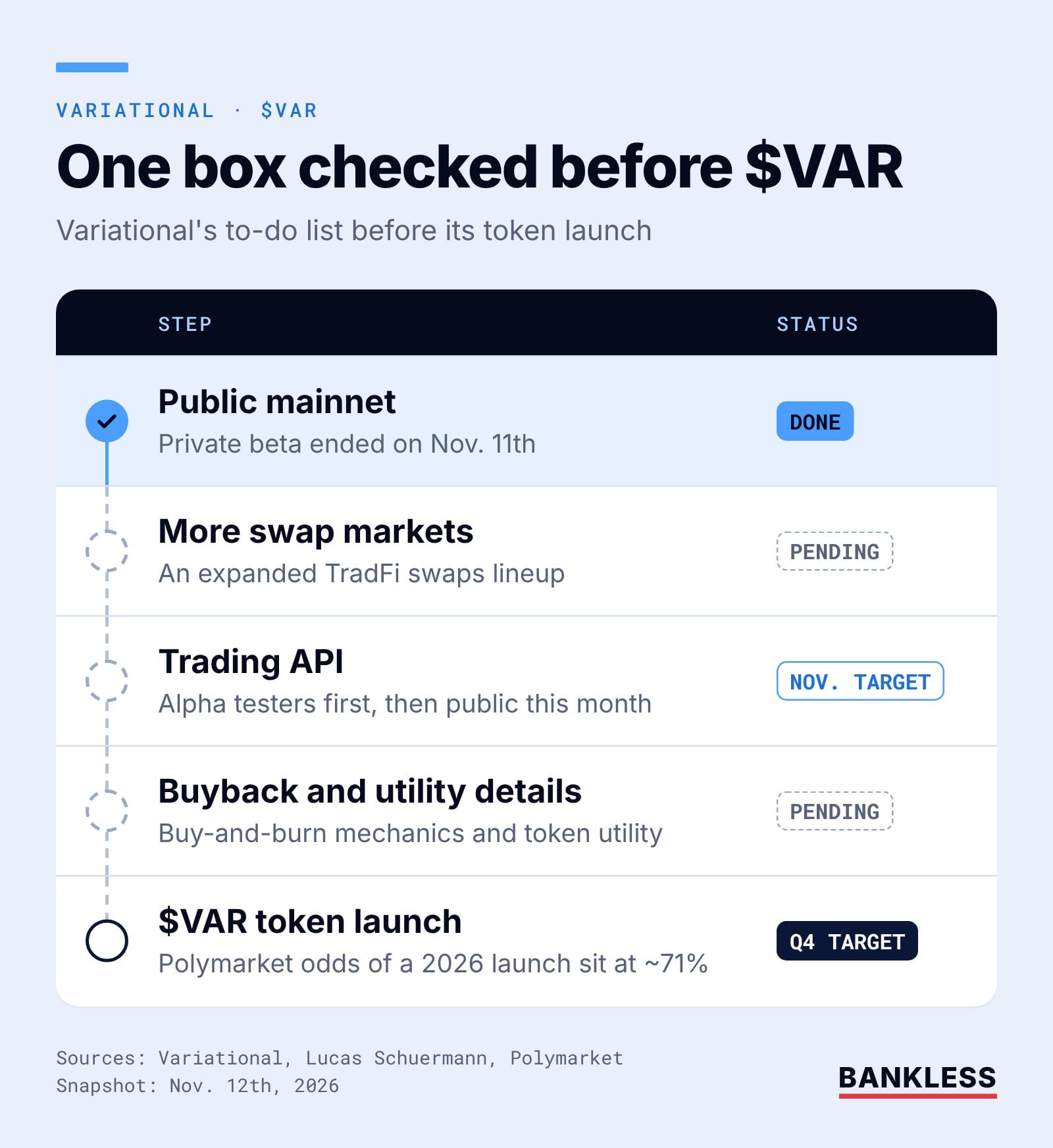
In a September 23 tokenomics post, Variational allocated 32% of the planned $VAR supply to a genesis airdrop for points holders, moved its token-generation event to the fourth quarter of 2026 and said it planned to use 100% of treasury revenue to buy back and burn $VAR. Those are plans, not completed token distributions or buybacks. Schuermann said on November 4 that the team still expected the event in 2026; he said a trading API had reached a small group of early testers and was expected to become publicly available that month. The proposed institutional platform, Variational Pro, had not launched.
At the time of the report, U.S. and Canadian residents could not use Omni. Its public phase therefore tested a specific exchange-infrastructure arrangement—isolated user collateral alongside a single maker responsible for quotes and external hedging—not an unrestricted or independently verified liquidity system.