In a November 17, 2026 report, TechFlow described a compatibility issue found while testing Ethereum’s proposed Glamsterdam upgrade on Sepolia: some simulated Juicebox transactions completed even though an internal payment failed. The finding concerns a proposed change to execution costs, not a rule already in effect on Ethereum mainnet.
Juicebox’s test cases showed different consequences depending on where the internal call failed:
- In an NFT purchase, the buyer received the NFT, but an out-of-gas internal payment to a related project did not complete. The unpaid funds remained in the payment project.
- In a token distribution, the reserved-token allocation completed, while a cross-project payment stopped. The intended recipient received the project’s original tokens rather than the result of the planned cross-project payment.
- In a cash-redemption test using between 679,622 and 817,622 gas, the redemption completed but an internal payment of the 2.5% protocol fee did not.
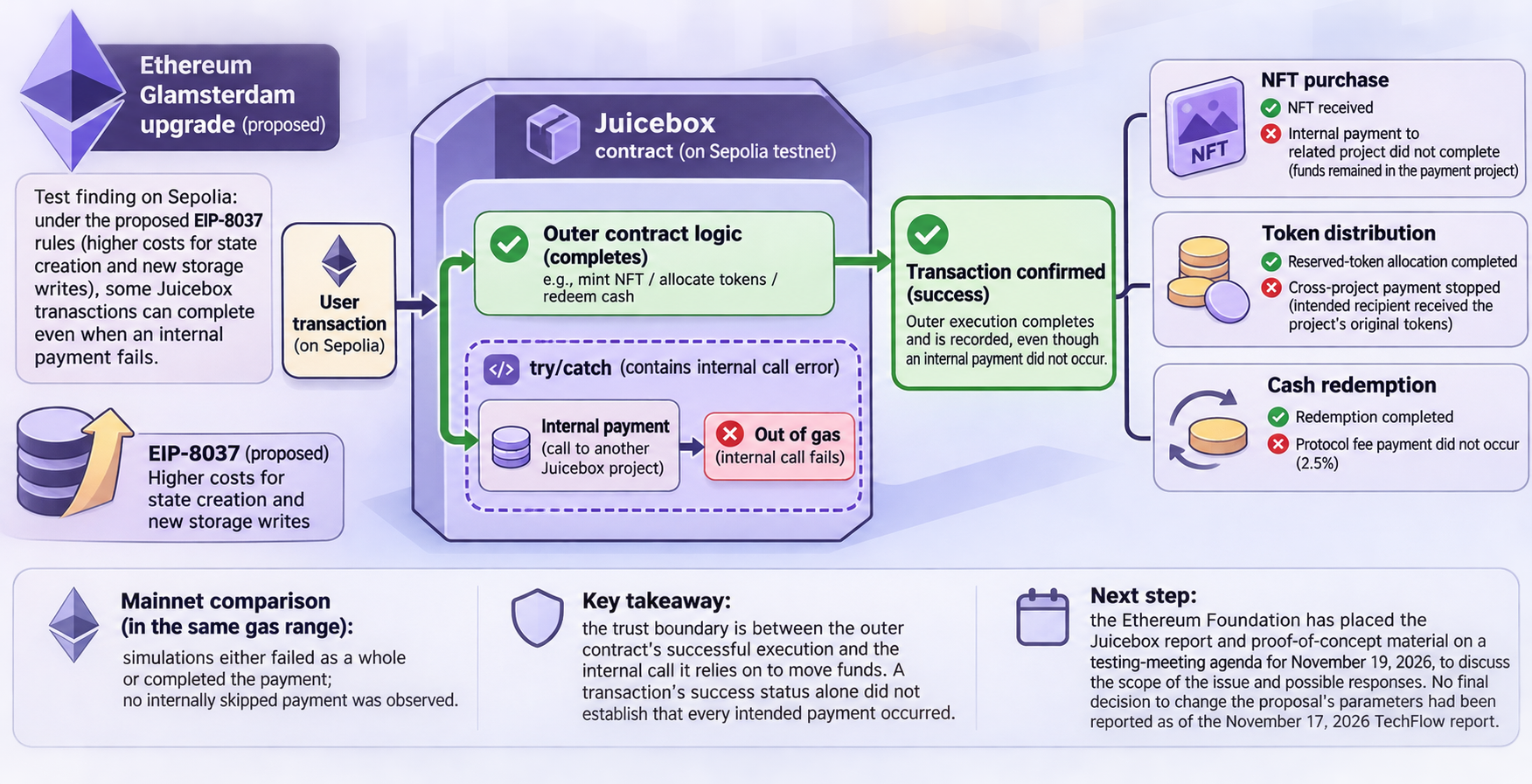
Juicebox developer mejango linked the behavior to higher costs for state creation and new storage writes under the proposed EIP-8037 rules. An internal call can run out of gas before the surrounding transaction does. Where a contract uses try/catch to contain that error, the outer transaction can continue and be confirmed without the payment. According to the report, comparable mainnet simulations in the same gas range either failed as a whole or completed the payment; they did not show an internally skipped payment.
The cross-project payment in these tests is a Juicebox contract interaction, not evidence of a cross-chain bridge. The relevant trust boundary is between the outer contract’s successful execution and the internal call it relies on to move funds. A transaction’s success status alone did not establish that every intended payment occurred.
TechFlow reported that the Ethereum Foundation had placed the Juicebox report and proof-of-concept material on a testing-meeting agenda for November 19, 2026, to discuss the scope of the issue and possible responses. At the time of the November 17 report, no final decision to change the proposal’s parameters had been reported.