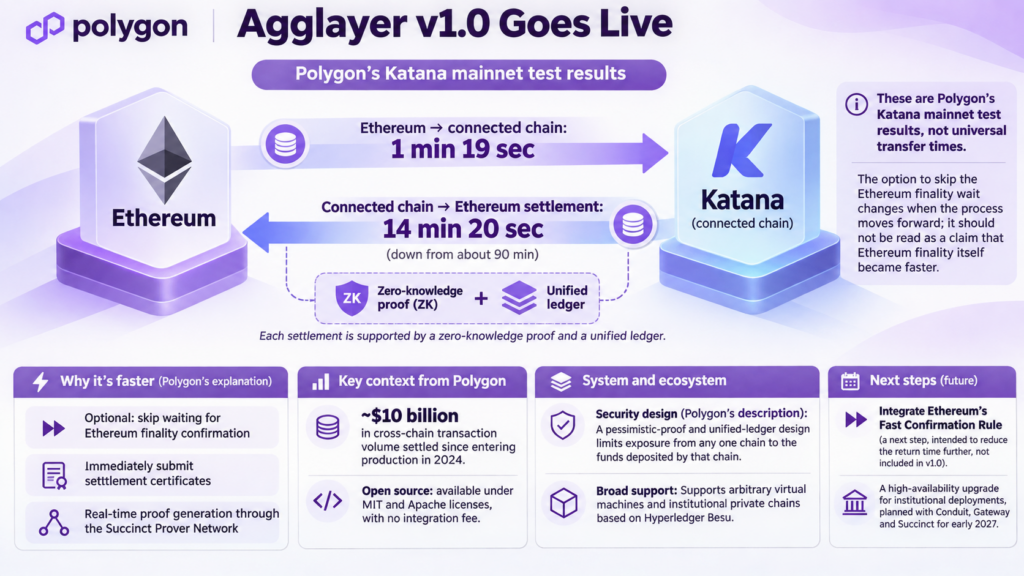
As reported on November 23, 2026, Polygon said Agglayer v1.0 was live. In a test on the Katana mainnet, Polygon measured 1 minute 19 seconds for an asset to move from Ethereum to a connected chain. Settlement in the reverse direction—from the connected chain back to Ethereum—took 14 minutes 20 seconds, down from about 90 minutes. Polygon said each settlement was supported by a zero-knowledge proof and a unified ledger.
Polygon attributed the speedup to three changes: an option to skip waiting for Ethereum finality confirmation, immediate submission of settlement certificates, and real-time proof generation through the Succinct Prover Network. The option to skip the finality wait changes when the process moves forward; the reported times should not be read as a claim that Ethereum finality itself became faster. Polygon said integrating Ethereum’s Fast Confirmation Rule was a next step intended to reduce the return time further, not a feature already included in v1.0.
Polygon also said Agglayer had settled nearly $10 billion in cross-chain transaction volume since entering production in 2024. It described the protocol as available under MIT and Apache open-source licenses with no integration fee. According to Polygon, its pessimistic-proof and unified-ledger design limits exposure from any one chain to the funds deposited by that chain. Those are Polygon’s descriptions of the system, not an independently verified security assessment.
Agglayer supports arbitrary virtual machines and institutional private chains based on Hyperledger Besu, Polygon said. A high-availability upgrade for institutional deployments, planned with Conduit, Gateway and Succinct for early 2027, remained a future plan at the time of the report.