Solana validators can still be executing transactions in a costly block when consensus has already settled on a competing block. On Nov. 23, 2026, contributor Philippe Laferrière opened a proposal for Agave, the validator client maintained by Anza, that would let validators cancel the remaining work once a sibling block is final.
The proposal offers an alternative to Laferrière’s Oct. 27 design, which would stop execution on an earlier signal but could require a validator to start over. As of Nov. 25, neither proposal had been adopted, and neither included benchmarks showing how much work it would save.
Why the cancellation signal matters
Validators re-execute the transactions in each block they receive to verify changes to balances and other onchain data. This process, called replay, usually finishes quickly. Both proposals target the exception: a block that is still consuming execution time when a consensus signal arrives.
According to the Solana Foundation’s October roundup, Alpenglow replaced TowerBFT on mainnet on Oct. 21 and targets finality in about 150 milliseconds. Under Alpenglow, validators vote on each slot, and their votes are aggregated into certificates. A skip certificate shows that enough stake voted to pass over a slot; it does not permanently rule out the block. Finalization of a sibling block does.
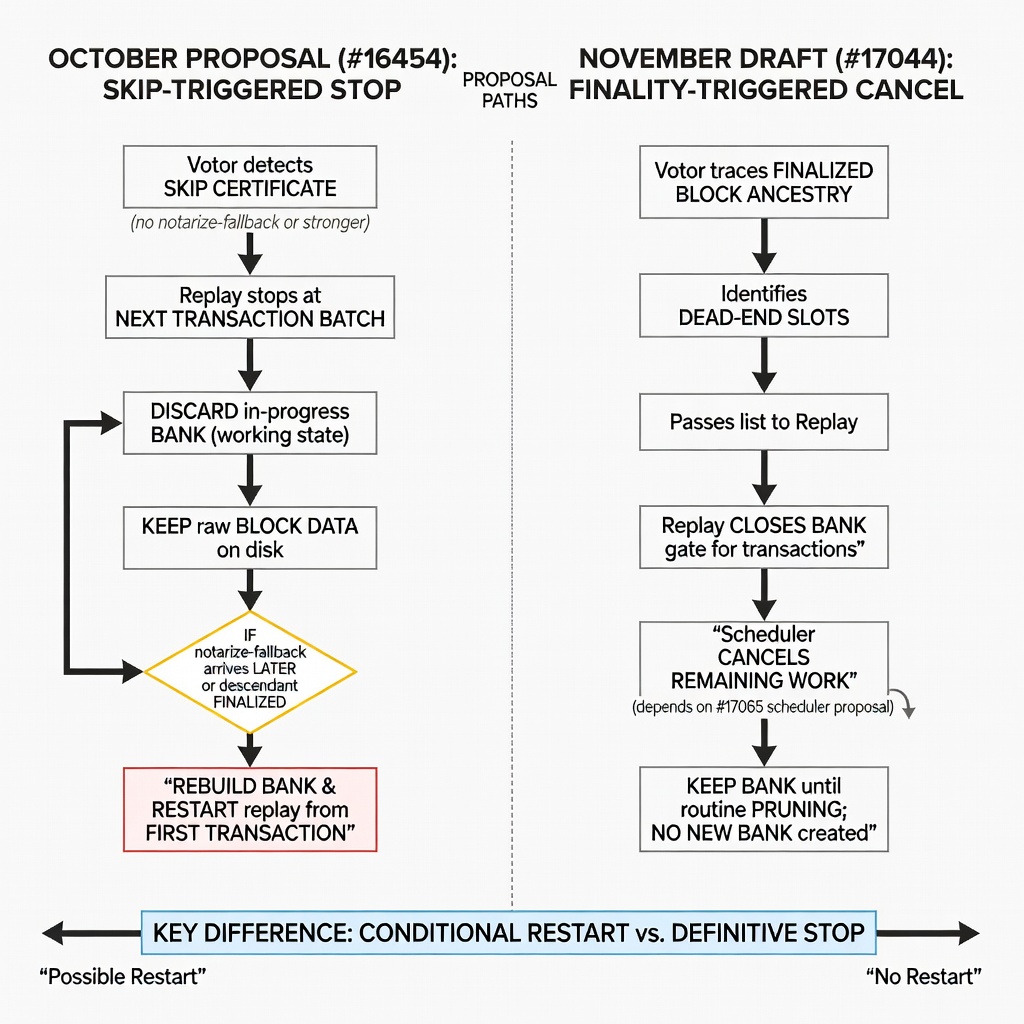
The November draft, #17044, uses that distinction. Votor, Alpenglow’s voting component, would trace the ancestry of finalized blocks to identify slots that can no longer be part of the finalized chain. It would pass that list to replay, which would stop admitting transactions for the affected block. The scheduler, which assigns transactions to execution threads, would cancel the remaining work. The validator would keep the block’s working state, called a bank, until routine pruning and would not create another bank for the slot.

What stopping earlier would change
Under the October proposal, #16454, Votor would act on a skip certificate if it had not seen a notarize-fallback certificate or anything stronger for that slot. Replay would stop at the next transaction batch. The validator would discard the bank but keep the raw block data on disk without marking the slot dead. Blocks the validator produced itself, and blocks it had already fully replayed, would be exempt.
That earlier cutoff could spare more work. But if a notarize-fallback certificate later arrived or a descendant were finalized, the validator would have to rebuild the bank and replay the block from its first transaction. During review, akhi3030 found that this restart could stall if peers supplied incomplete data. Laferrière addressed the issue by routing the retry through Agave’s existing recovery mechanism.
Waiting for a sibling to finalize removes the need for that restart logic, Laferrière wrote. The trade-off is timing: by the time the rival block is final, the validator may already have executed most of the costly block.

A scheduler dependency and an unmeasured benefit
The November design also needs the replay thread to be available to receive the cancellation signal. It depends on a separate scheduler proposal, #17065, that would keep replay from blocking while the scheduler finishes processing a block. Laferrière noted that replay had previously waited at the block footer, which marks the end of the block. Even with the proposed change, replay could still have to wait for a transaction already executing to finish.
As of Nov. 25, the scheduler proposal was open and had to merge before #17044 could leave draft status. The latter moved to draft on Nov. 24; two engineers had been asked to review it, but neither had submitted a review. The October proposal remained open with a partial review and further reviews outstanding.
The unresolved question is how often a costly block loses while replay is still underway, and how much work remains at each signal. Both designs add a metric called replay-slot-cancelled-stats to record cancellations. The October version would also record how long execution ran before cancellation. Without measurements from validators running the code, the benefit of stopping earlier remains unknown.