
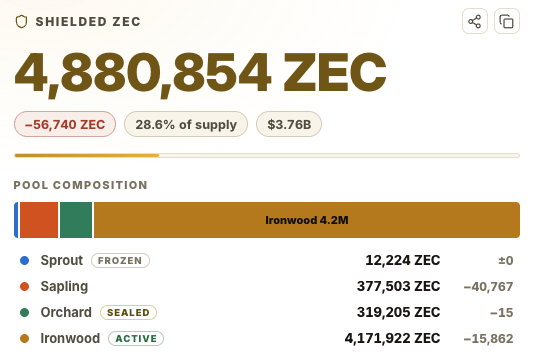
Zakura called for Zcash to disable payments into Sapling, its older shielded pool, in an analysis that Odaily reported on November 26, 2026, at 13:47:05 UTC+8. Sapling held nearly 400,000 ZEC, about 2% of the total supply. The recommendation was precautionary: Zakura described a practical break of pairing-based cryptography as speculative, not a demonstrated attack or a loss of funds.
What Sapling relies on, and what could be recovered
Sapling uses pairings to verify zero-knowledge proofs. Its private keys and note commitments, the records against which users can later prove a claim to funds, do not depend on pairings. A pairing break could therefore let an attacker forge a proof without obtaining a user’s key. According to Zakura, neither Zcash’s transparent funds nor funds in its newer Ironwood shielded pool face that particular risk.
Zakura proposed two distinct steps. First, a network upgrade would stop new payments into Sapling and accelerate its retirement. Most wallets already supported both Sapling and Ironwood, according to the analysis. Fewer than 2.6% of transactions used Sapling in the 30 days examined. Of those, 66% were identifiable as miner flows; Zakura suspected miners accounted for much of the remainder as well.
Second, if credible evidence of a pairing break emerged, Zakura recommended freezing the entire pool before forged proofs could corrupt its state. With the original note commitments intact, developers could build a replacement proof system that reused Sapling’s circuit logic but relied on hashes or the elliptic-curve discrete logarithm problem instead of pairings. That would give users a way to recover frozen funds later. Neither the freeze nor the recovery mechanism was reported as active.
Why a factoring advance would not establish a pairing break
Zakura discussed a claimed AI proof of the Riemann hypothesis and rumors of an unpublished advance in integer factoring. The proposed link involves smooth numbers, whose prime factors are all small. Variants of the number field sieve used in factoring and in attacks on pairing-based systems need smooth numbers that satisfy particular constraints. A better estimate of how many exist is not necessarily a faster way to find them. And because the two applications use different mathematical relations, even a practical speedup for factoring might not carry over to pairings.
As a practical benchmark, Zakura cited Cognition’s factorization in September of RSA-260, an 862-bit integer. Its GPU implementation reportedly cut costs tenfold relative to the best previously published approach. That was a measured improvement, not evidence of the rumored billionfold speedup. Even a polynomial-time factoring algorithm would not necessarily be useful at cryptographic key sizes if its exponent were too large.
For the BLS12-381 pairing curve, Zakura put the theoretical workload near that of factoring a 2,630-bit RSA modulus. An instruction-level estimate from CurveSmash put it closer to RSA-3072 once practical costs such as memory access and data movement were considered. Zakura’s extrapolations put the respective costs at about $323 quintillion and $100 sextillion. Under a separate scenario assuming a billionfold practical improvement, Zakura estimated a cost of $1 trillion to $300 trillion and months or years of computation. These were projections, not observed attack costs. Zakura expected the smaller-field BN-254 curve to be vulnerable before BLS12-381.
The distinction matters beyond Zcash: a practical pairing break could require chains that rely on pairing-based consensus signatures, including Ethereum and Solana, to change signature schemes. It would not, by itself, imply that ordinary user account keys had been compromised.
Separately, Zakura said a proposal was being prepared to introduce SPHINCS+ (SLH-DSA-192) for Zcash transparent transactions. The hash-based signature scheme would target 192-bit security and provide a post-quantum option. It was a proposed upgrade, not a response to a confirmed weakness in transparent transactions.