In an analysis published on November 19, 2026, imToken examined a practical question behind Ethereum’s post-quantum plans: if today’s signature schemes eventually become vulnerable, how can people retain control of their existing accounts and assets while changing the keys that authorize transactions?
The threat is not immediate. imToken noted that no quantum computer capable of breaking the cryptography used by mainstream blockchains had emerged. But a migration across accounts, validators and applications would take time, which is why the work matters before such a machine exists.
Where the exposure lies
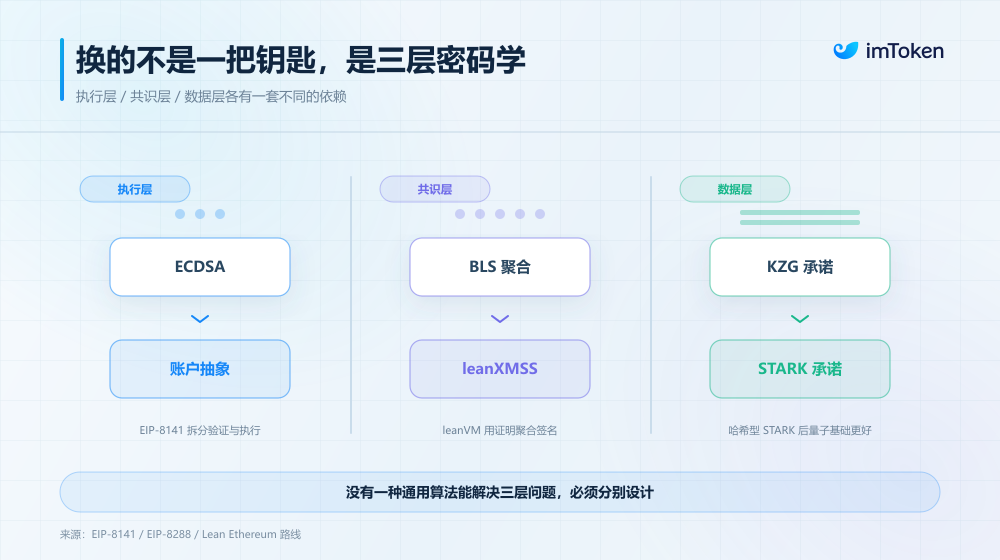
Ordinary Ethereum accounts use ECDSA signatures. Validators use BLS signatures, whose aggregation helps the proof-of-stake network handle large numbers of votes. A sufficiently capable fault-tolerant quantum computer running Shor’s algorithm could, in theory, undermine the elliptic-curve assumptions behind both. The same long-term concern applies to keys controlling protocol multisignature arrangements and cross-chain bridges: their holders must still be able to authorize actions securely.
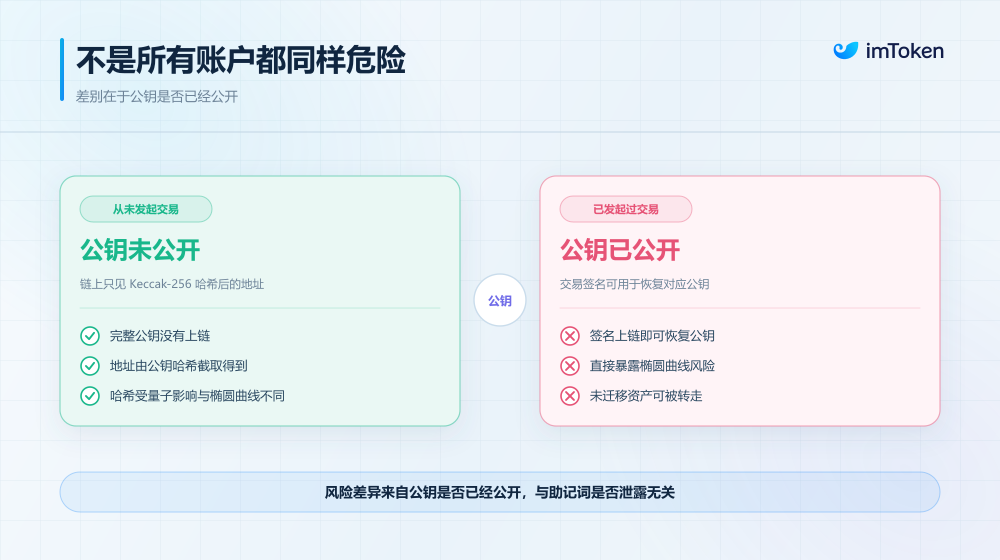
Exposure differs among ordinary accounts. An Ethereum address is derived from a hash of its public key. If an account has never sent a transaction or publicly disclosed a signature, its full public key is not exposed in that way. Once it signs a public transaction, the signature allows the public key to be recovered. That distinction matters to the future quantum threat; it does not mean users need to move funds now.
The work also extends beyond signatures. Ethereum’s KZG commitments, used in blob and rollup data availability, rely on elliptic-curve-related assumptions. Some pairing-based SNARKs face a similar concern, while hash-based STARKs do not rely on the same elliptic-curve discrete-logarithm assumption. imToken therefore framed post-quantum migration as an issue for L1, rollups and applications—not just wallets.
Proposed changes, not completed protections
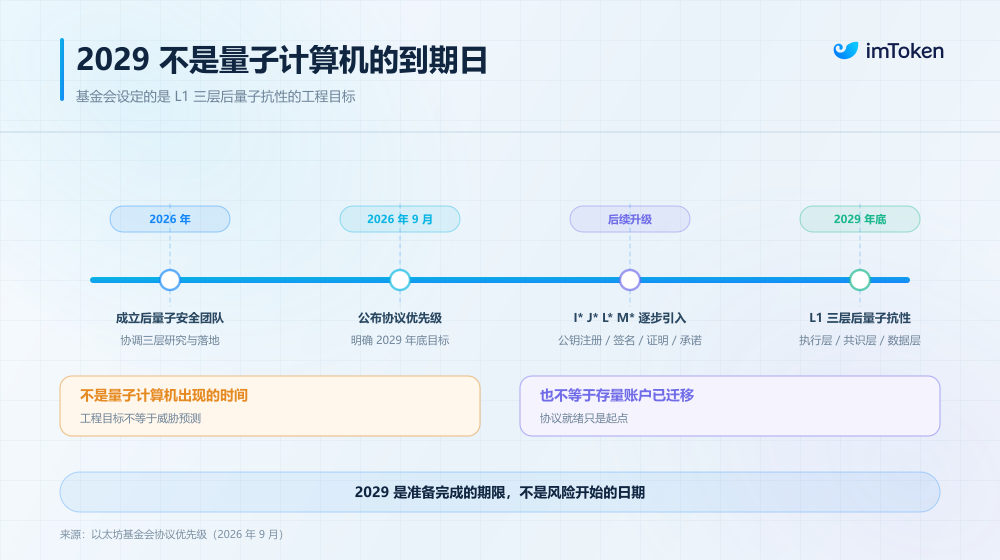
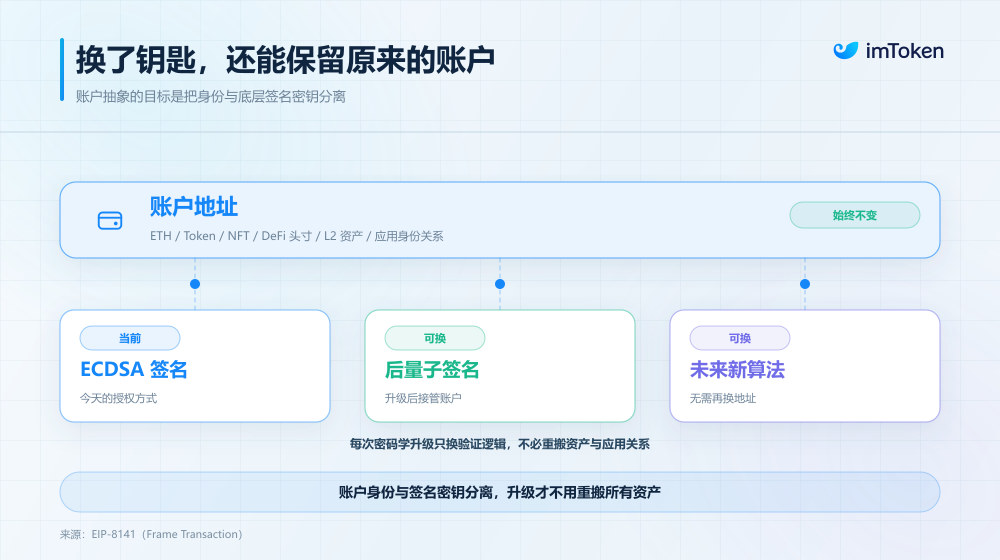
According to imToken, the Ethereum Foundation formed a Post-Quantum Security team in 2026. Its September 2026 protocol priorities set a December 2029 target for post-quantum resistance across Ethereum L1’s execution, consensus and data layers. That is an engineering goal, not a claim that the protections are already in place.
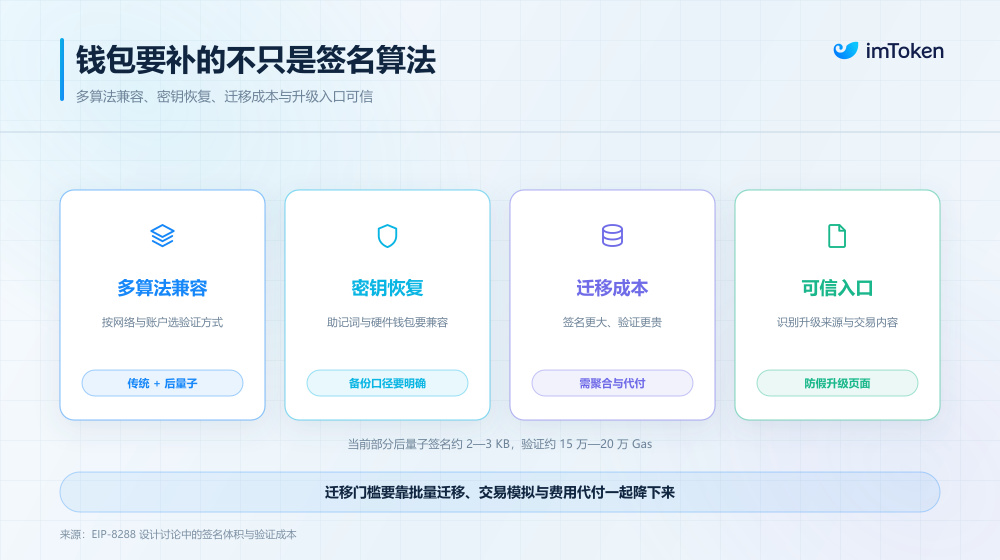
On the execution layer, the proposed EIP-8141 would separate transaction validation, execution and gas payment. Programmable validation could give accounts a path to change authorization methods without permanently tying them to one ECDSA key. Post-quantum signature-verification precompiles are also under study. Because those signatures can be much larger than current ones, EIP-8288 proposes using recursive STARK aggregation to reduce verification and data burdens.
For consensus, the Lean Ethereum approach discussed by imToken includes leanXMSS, a proposed hash-based replacement for validator BLS signatures, and leanVM, intended to aggregate post-quantum signature verification into compact proofs. These are distinct tasks: changing a wallet’s authorization rule does not, by itself, change how validator votes are verified.
The handoff that matters to users
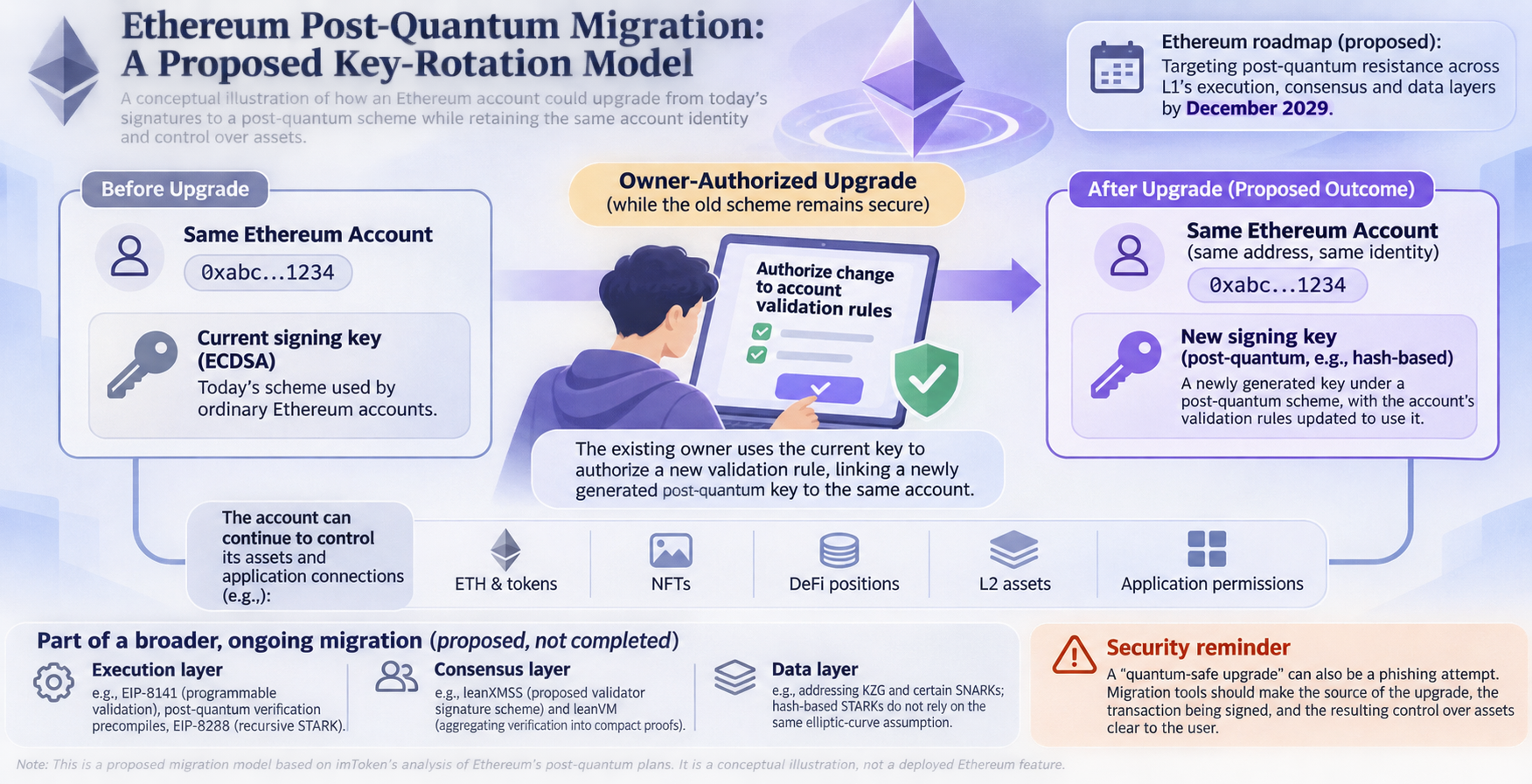
For a traditional externally owned account, adopting a different key system can mean adopting a different address. Moving ETH or tokens is only part of that handoff: an address may also be associated with NFTs, DeFi positions, L2 assets and application permissions. Account abstraction aims to separate account identity from its underlying signing key, potentially allowing a change in verification rules while retaining an address. That outcome depends on the account design and the proposed changes being implemented.
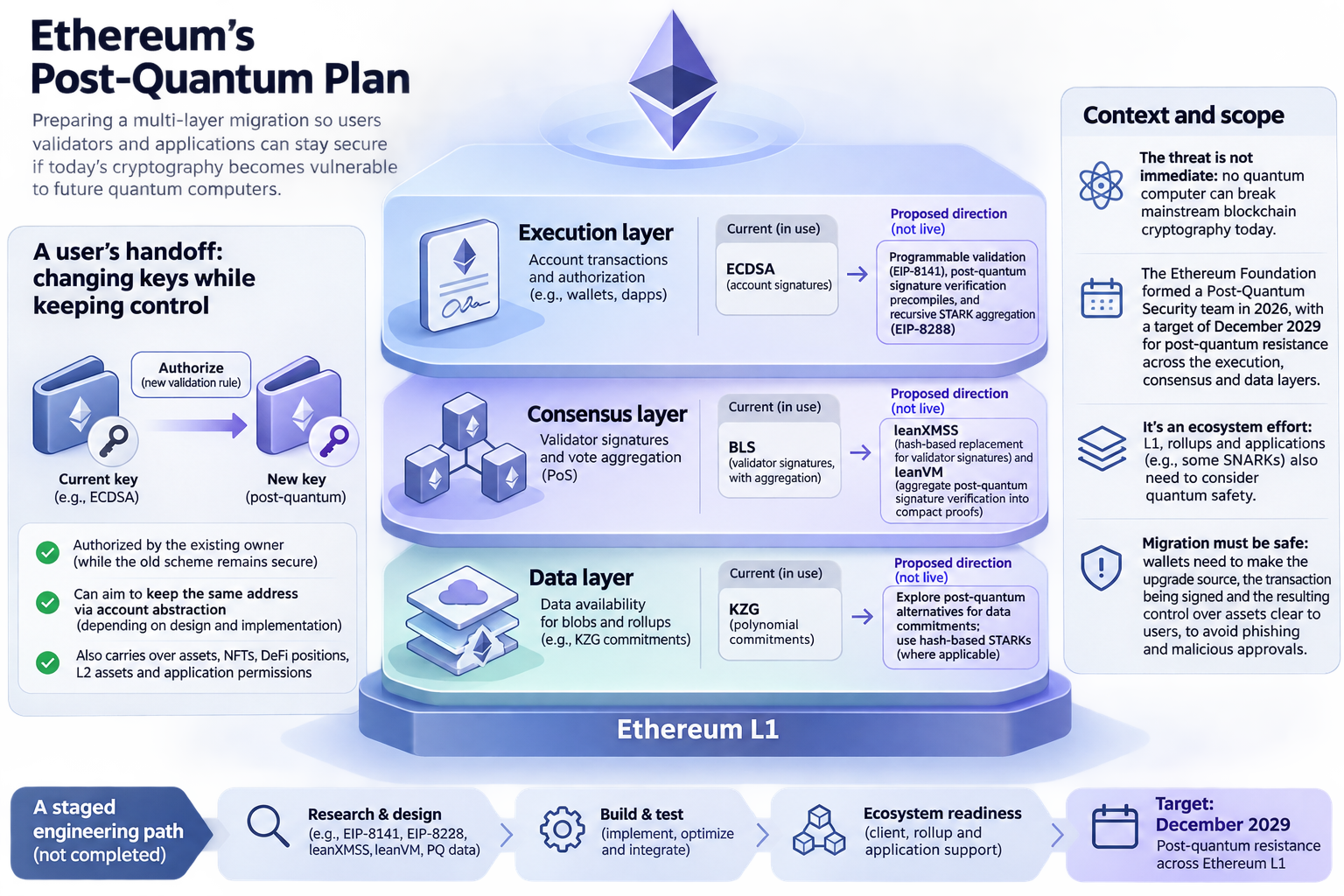
imToken described the preferred migration as one authorized by the existing owner while the old signature scheme remains secure: a wallet generates a new key, and the current account authorizes the new validation rule. If attackers can already forge signatures under the old scheme, an old-key signature alone can no longer establish which claimant is the owner. Dormant or lost-key accounts present a separate unresolved question, including whether any future governance response should leave them untouched or restrict them.
That authorization step is also a trust boundary for wallets. A purported “quantum-safe upgrade” could instead be a phishing page seeking a seed phrase or a malicious approval. The immediate task is not a rushed asset transfer, but designing migration tools that make the source of an upgrade, the transaction being signed and the resulting control over assets clear to the user.